Future Welding Fume Controls for UK Workshops

A welding bay can look clear while the operator is still breathing a harmful concentration of fume. That is why future welding fume controls are not simply about buying a bigger extractor. They are about capturing fume at the arc, proving that the system is working, and making control part of the daily production routine.
For UK fabrication businesses, the pressure is real. Mild steel welding fume is recognised as a carcinogen, while stainless steel and high-alloy work can introduce additional hazards such as chromium and nickel compounds. Add confined spaces, repair work, awkward fabrications and changing production schedules, and a one-size-fits-all extraction setup soon falls short.
The workshops that stay ahead will combine well-specified local exhaust ventilation, practical welding methods, suitable respiratory protective equipment and proper servicing. It is a safety decision, but it is also an operational one. Less airborne fume means a cleaner shop, better visibility, less contamination around machinery and fewer interruptions when customers need work turned around.
Why future welding fume controls start at the arc
The first priority remains source capture. General workshop ventilation can dilute fume, but it does not reliably stop the welder breathing it before it spreads. Opening roller shutters or fitting a few wall fans may make a building feel fresher, yet it is not a substitute for effective local exhaust ventilation, commonly called LEV.
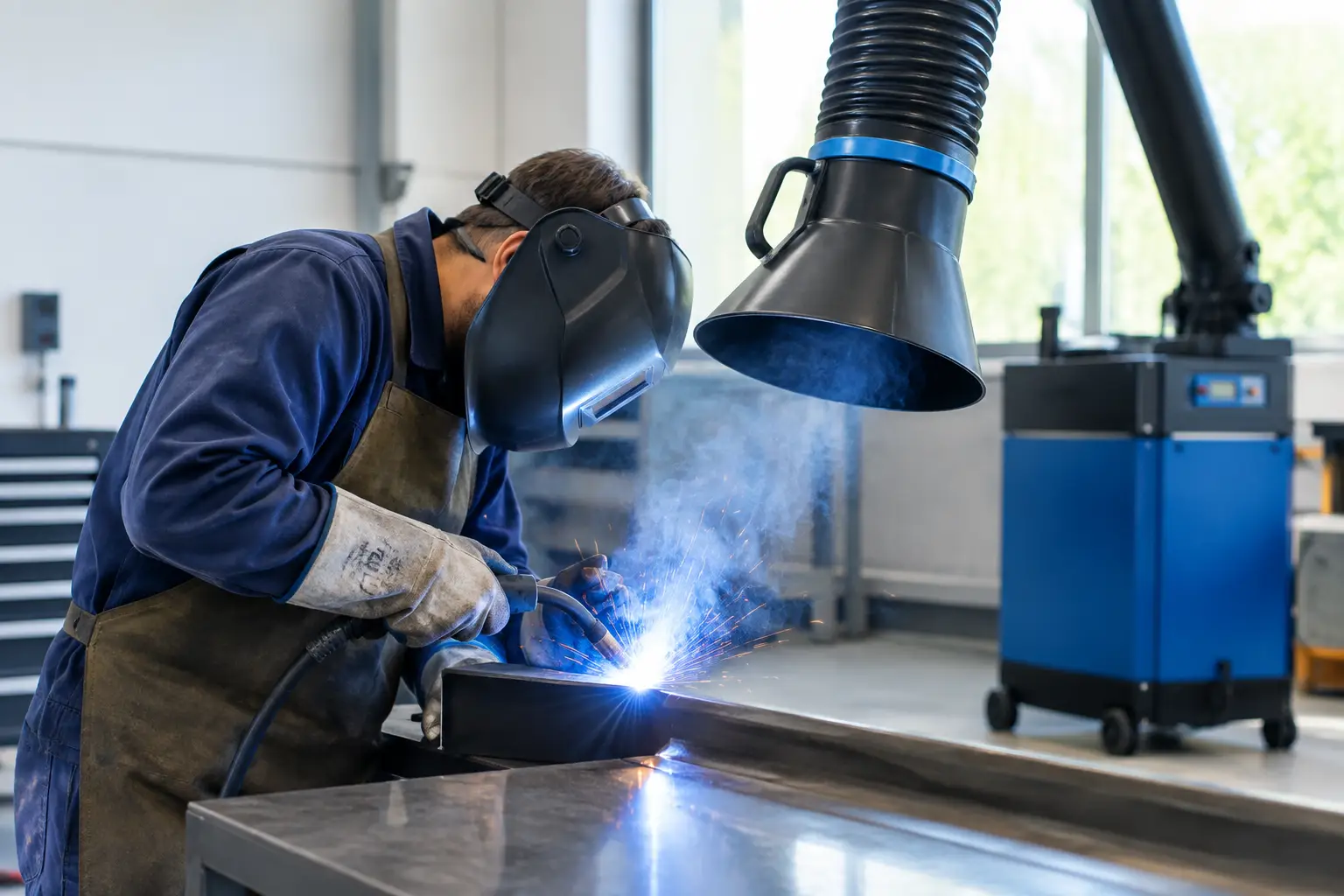
The strongest control is usually the one that gets closest to the fume plume without getting in the welder’s way. For bench fabrication, that may mean an extraction arm positioned correctly and re-positioned as the weld moves. For repetitive MIG production, on-torch extraction can capture fume consistently without relying on an operator to move an arm every few minutes. Downdraught benches and backdraft tables suit certain component sizes and processes, while enclosed or partially enclosed booths can provide excellent control for repeatable work.
There is a trade-off in every option. Extraction arms are flexible and cost-effective, but only when they are close enough and correctly placed. On-torch systems are highly practical for production welding, but the torch, consumables and extraction unit must be matched properly. A full enclosure can give the best containment, yet may restrict access for large fabrications or increase handling time.
The right question is not, “Which extractor is best?” It is, “How is this job actually welded, shift after shift?” That includes joint position, wire process, consumables, component size, duty cycle and whether the operator can keep the capture point in the correct place.
Better controls will be designed around real welding work
Future-ready fume control systems will be less forgiving of poor positioning and more helpful to the operator. Expect better hood designs, lighter extraction arms, automatic airflow adjustment and clearer status indicators at the point of use. If airflow drops, the welder should not need to walk to a plant room or wait for someone to notice a warning light on the main unit.
This does not remove the need for training. Even the best LEV cannot capture fume effectively if the hood is parked too far away, the welding plume is travelling away from it or the system has been switched off to reduce noise. The best installations are specified with the people doing the work, not just from a floor plan.
Smarter monitoring will change future welding fume controls
Extraction equipment has traditionally been checked when it sounds different, loses suction or fails its scheduled test. That approach is reactive. The next generation of workshop controls will make airflow, filter condition and operating time far more visible.
Simple visual indicators already help operators see whether a unit is running. The next step is connected monitoring that records airflow, pressure drop and filter loading over time. A supervisor can spot a gradual loss of performance before it becomes a failed control measure. Maintenance teams can order filters and plan servicing around actual condition rather than relying only on a calendar.
This matters because an extraction unit can be switched on but still underperform. Blocked filters, damaged ducting, poor hood positioning and incorrect fan settings can all reduce capture. Monitoring will not fix these faults by itself, but it gives workshops the information needed to act sooner.
Air-quality sensors will also become more common, particularly in larger fabrication bays and training centres. Used correctly, they can show trends, identify high-fume activities and support decisions on layout or shift patterns. They are not a replacement for source capture or a COSHH assessment. A sensor measuring background conditions cannot guarantee what an individual welder is breathing at the point of work. It is an extra layer of evidence, not a shortcut.
Automation can reduce exposure, but not remove responsibility
Cobot welding cells and automated systems can move operators further from the arc during repeat production. This can reduce direct exposure and improve consistency, especially where parts can be fixtured accurately. It can also make enclosure and extraction design easier because the welding zone is fixed.
But automation changes the risk rather than making it disappear. Someone still loads components, changes wire, cleans the cell, checks welds and carries out maintenance. Fume needs controlling during production, and the enclosure must be considered alongside guarding, access, heat, fire risk and the movement of people and materials.
For many UK workshops, a cobot is not the immediate answer. A well-positioned extraction arm or on-torch system may deliver a bigger safety improvement per pound spent. Automation earns its place where the volume, repeatability and labour case stack up. The control strategy should follow the work, not the latest brochure.
Filter choice, maintenance and testing still decide performance
Smart technology is useful, but the basics will remain non-negotiable. A quality extraction system needs the right airflow, appropriate filtration, correctly sized ducting and a discharge arrangement suited to the site. Welding fume is not just visible dust. Depending on the process and material, it can contain very fine particulate and hazardous metal compounds, so filter performance and safe filter handling matter.
Maintenance has to be planned as part of ownership. Pre-filters, main filters, spark arrestors, hoses, arms and extraction nozzles all need inspection. A damaged flexible hose or a clogged filter can undermine the whole system. Cleaning should not send collected dust back into the workshop either. Follow the equipment instructions and use safe methods suited to the contaminants involved.
Under COSHH, LEV requires thorough examination and testing at suitable intervals. For most welding LEV systems, that is at least every 14 months, although site risk assessments, usage levels and equipment instructions may justify more frequent checks. This formal test is not the same as a quick look-over by the operator. Both are needed.
A practical routine is simple: operators check that extraction is running before work starts and report poor suction straight away; supervisors make sure hoods and arms are being used correctly; and competent engineers carry out scheduled servicing and formal LEV testing. Keep records. They support compliance, but more importantly, they show whether the control is genuinely being maintained.
PPE remains the final line of defence
Respiratory protective equipment should sit alongside engineering controls, not replace them. There are jobs where RPE is essential: welding in awkward positions, short-duration repair work, confined-space tasks or work where effective LEV cannot be set up. The right mask, filter type, face-fit testing and clean-shaven seal area all matter.
Welding helmets with powered air systems can be a sensible option where exposure is difficult to control or operators need a practical all-day solution. They are not a licence to weld in a cloud of fume. If the air is visibly contaminated, start by checking the process, positioning and extraction before treating PPE as the answer.
Training also needs to cover the small habits that affect exposure: keeping the head out of the plume, positioning extraction before striking up, closing booth curtains where fitted and reporting damaged equipment. These are straightforward actions, but they are where a control plan succeeds or fails.
Build the next upgrade around the work you do now
Before buying new fume equipment, walk the workshop during a busy shift. Watch where fume travels, which stations produce the heaviest load, where arms are left unused and which jobs force welders into awkward positions. Review material types, welding processes and the hours spent at each bay. That gives a far better starting point than choosing equipment by extraction rate alone.
A staged upgrade often makes commercial sense. Improve source capture at the highest-exposure stations first, bring existing LEV back to proper condition, then add monitoring or purpose-built booths as production grows. Linc-Weld can support the practical side with equipment advice, LEV testing and engineering support, helping workshops match controls to real fabrication work rather than a generic specification.
The future of welding fume control is not a distant concept. It is a cleaner, better-managed workshop where extraction is easy to use, performance is visible and nobody has to guess whether the air around the arc is safe.