Best MIG Wire Types for Clean, Reliable Welds

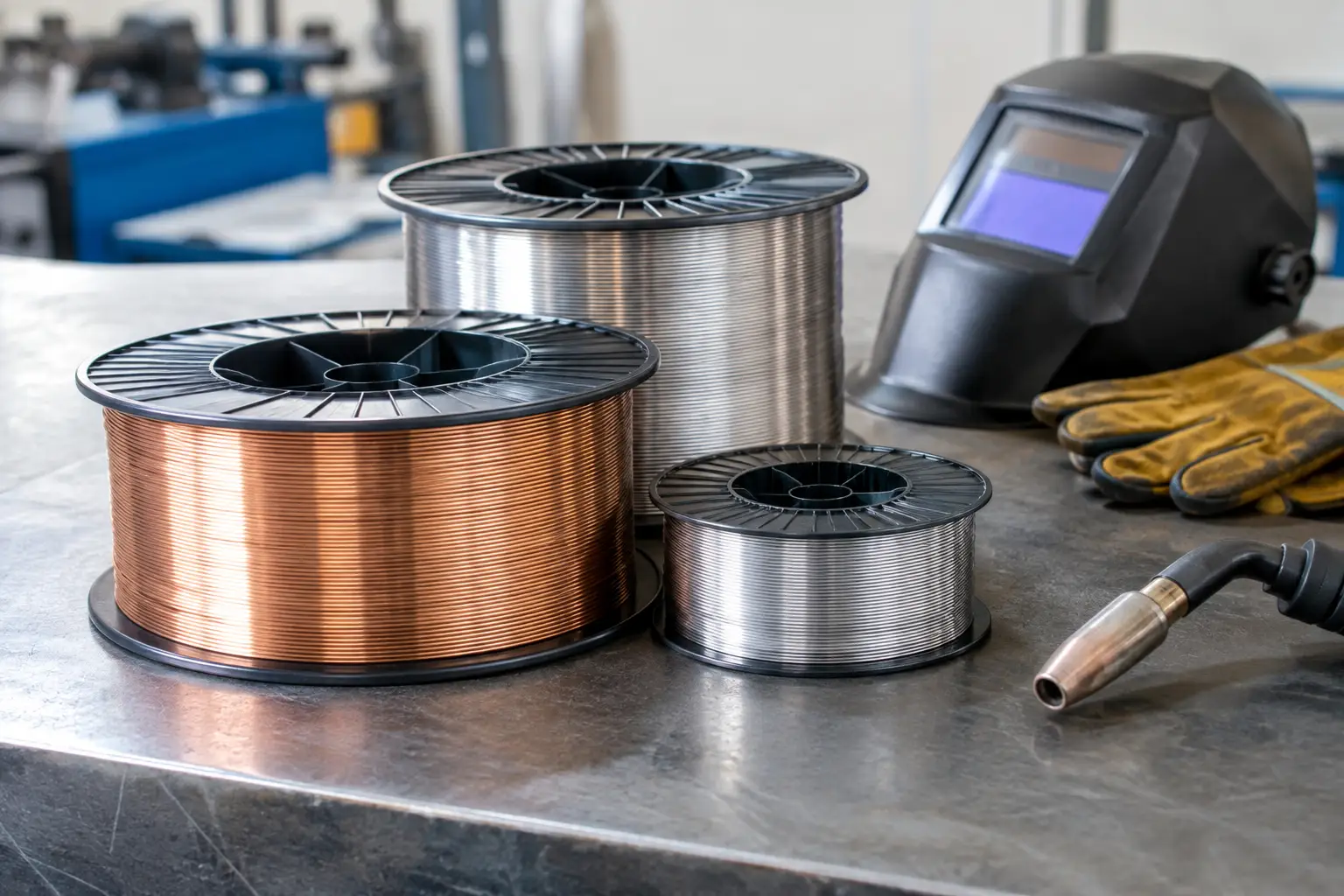
A MIG set can be correctly configured and still produce poor results if the wire is wrong for the job. The best MIG wire types are not simply the most expensive reels on the shelf. They are the wires that match the parent material, joint condition, shielding gas, power source and the way the work will be used. Get that combination right and you will see a steadier arc, cleaner bead profile and less time spent dressing welds.
For fabrication shops, maintenance teams and site welders, wire choice is also a cost decision. A cheaper reel that causes feed issues, porosity or excess spatter soon costs more in rework than a quality consumable ever did.
Best MIG Wire Types for Common Workshop Jobs
ER70S-6 solid wire for everyday mild steel
ER70S-6 is the standard choice for most mild-steel MIG work in UK workshops. It is a solid, copper-coated wire with a relatively high level of deoxidisers, helping it cope with mill scale, light surface rust and minor contamination better than cleaner-grade mild-steel wires.
It is well suited to general fabrication, brackets, box section, gates, agricultural repairs and structural work where the material has been properly prepared but is not perfectly bright. Used with an argon/CO2 mixed gas, ER70S-6 gives a stable arc, good wetting at the weld toes and a tidy finish. It will also run on pure CO2, although expect more spatter and a harsher arc.
For most customers buying wire for a standard MIG machine, ER70S-6 should be the starting point. It is versatile, readily available in common spool sizes and works across a wide range of machine outputs.
ER70S-3 solid wire for cleaner steel
ER70S-3 is another mild-steel solid wire, but it has lower deoxidiser content than ER70S-6. That makes it a good fit for clean, new steel where the material has little scale, oil or rust. It can produce a neat, consistent weld on well-prepared components, particularly in controlled fabrication environments.
The trade-off is preparation. ER70S-3 is less forgiving when welding dirty or scaled steel. If the job involves outdoor repairs, old stock or material straight from a steel rack, ER70S-6 is usually the safer and more productive option.
Gasless flux-cored wire for mobile repairs
Self-shielded flux-cored wire is often called gasless MIG wire. It creates its own shielding through the flux inside the wire, removing the need for a gas cylinder and regulator. That makes it useful for outdoor work, mobile repairs and jobs where wind would blow conventional shielding gas away.
Gasless wire runs differently from solid wire. It generally produces more fumes, more spatter and a slag layer that must be removed between passes. Wire polarity is also critical: many self-shielded wires require the torch to be connected negative, often marked DCEN or electrode negative. Check the reel specification and your machine instructions before changing over.
For fabrication carried out indoors, solid wire with mixed gas will normally give a cleaner result. Gasless wire earns its place when portability and wind resistance matter more than cosmetic finish.
Stainless MIG wire for corrosion-resistant work
Stainless wire must match the grade of the parent material as closely as practical. For 304 stainless, ER308LSi is the usual choice. The low-carbon L grade helps reduce the risk of carbide precipitation, while the silicon content improves fluidity and bead appearance.
ER316LSi is used for 316 stainless, including applications where improved corrosion resistance is needed, such as marine, food-processing and chemical-service work. ER309LSi is commonly used for joining stainless steel to mild steel or as a buffer layer before cladding.
Do not treat stainless welding as a simple wire swap. Keep stainless work separate from carbon-steel grinding dust and contamination, use suitable shielding gas, and ensure contact tips, liners and wire feed parts are clean. A contaminated stainless weld can undermine the very corrosion resistance the material was chosen for.
Aluminium MIG wire: 4043 and 5356
Aluminium needs a dedicated approach. ER4043 is a popular aluminium-silicon wire, widely used for castings and many 6xxx-series aluminium jobs. It flows well, has good crack resistance and is generally easier to weld than some alternatives.
ER5356 is an aluminium-magnesium wire used where higher weld strength, better colour match after anodising or improved performance on certain marine-grade alloys is required. It is often specified for 5xxx-series aluminium. The right choice depends on the base alloy and service conditions, so guessing can be costly on structural or coded work.
Aluminium wire is soft, which makes wire feeding a major part of the job. A spool gun or push-pull torch is often the sensible answer, especially with longer torch leads. Use 100% argon, a suitable aluminium liner and the correct contact tip. If the feed is inconsistent, changing to premium wire alone will not fix a damaged liner or an over-tightened drive roll.
Choosing MIG Wire Diameter
Wire diameter controls how easily you can manage heat input and how well the wire feeds at a given output. The right size depends on material thickness, welding position and machine capability.
For thin sheet steel, 0.6 mm wire gives more control at lower amperage and helps reduce the risk of blowing through. It is a sensible choice for vehicle panels, light box section and thin fabrication. For general workshop work, 0.8 mm is the most useful all-round size. It covers a broad range of mild-steel jobs and performs well on many single-phase MIG sets.
Once material gets thicker or production output increases, 1.0 mm and 1.2 mm wire become more practical. They support higher deposition rates and deeper penetration, but need enough machine power to run properly. Trying to force 1.0 mm wire through a small machine at low settings can leave you with a cold, untidy weld rather than a stronger one.
Shielding Gas Still Matters
The wire and gas work as a system. For mild steel, an argon/CO2 mix is the usual workshop choice because it provides a stable arc and lower spatter than pure CO2. A higher argon content generally improves arc smoothness and bead appearance, while additional CO2 can provide more penetration at the expense of increased spatter.
Stainless normally requires a stainless-specific mixed gas, chosen for the transfer mode and application. Aluminium requires pure argon for standard MIG work. Using the wrong gas can cause porosity, poor bead shape and unstable arc behaviour, even when the wire is correct.
Before blaming the wire, check gas flow, leaks, torch consumables and draughts around the weld area. A reel of good wire cannot overcome a split gas hose or an empty cylinder.
How to Buy the Right Reel First Time
Start with the material grade, then consider its condition. Clean mild steel and rusty farm equipment are both steel, but they do not demand the same level of wire tolerance or preparation. Next, check your machine’s wire-feed capability, polarity options, spool size capacity and torch liner compatibility.
For regular production work, larger reels usually offer better value per kilogram and reduce changeover downtime. Smaller reels make more sense for occasional stainless or aluminium jobs, where keeping wire sealed, clean and clearly identified is more valuable than buying volume.
Also consider the quality of the reel itself. Consistent wire diameter, clean copper coating and orderly winding all support stable feeding. Bird-nesting at the drive rolls, erratic arc performance and burn-backs are often consumable or setup problems, not machine faults.
Keep Wire Clean and Ready to Run
Store MIG wire somewhere dry, away from grinding dust, moisture and sudden temperature changes. Leave a reel exposed in a damp workshop long enough and surface contamination can lead to feeding issues and porosity. Keep it in its original packaging where possible, particularly stainless and aluminium wire.
Check the drive-roll groove matches the wire type and diameter. V-groove rolls are standard for solid steel wire, while knurled rolls are commonly used for flux-cored wire. Aluminium needs gentler handling, usually with U-groove rolls, because aggressive knurling can crush the wire.
The quickest route to better MIG results is rarely more heat or a more expensive machine. Match the wire to the metal, set up the feed system properly and use the gas it was designed for. If the job has an unusual alloy, demanding service environment or repeat production requirement, getting a straight answer before ordering the reel will save time at the bench.