
TIG Torch Spare Parts That Actually Matter

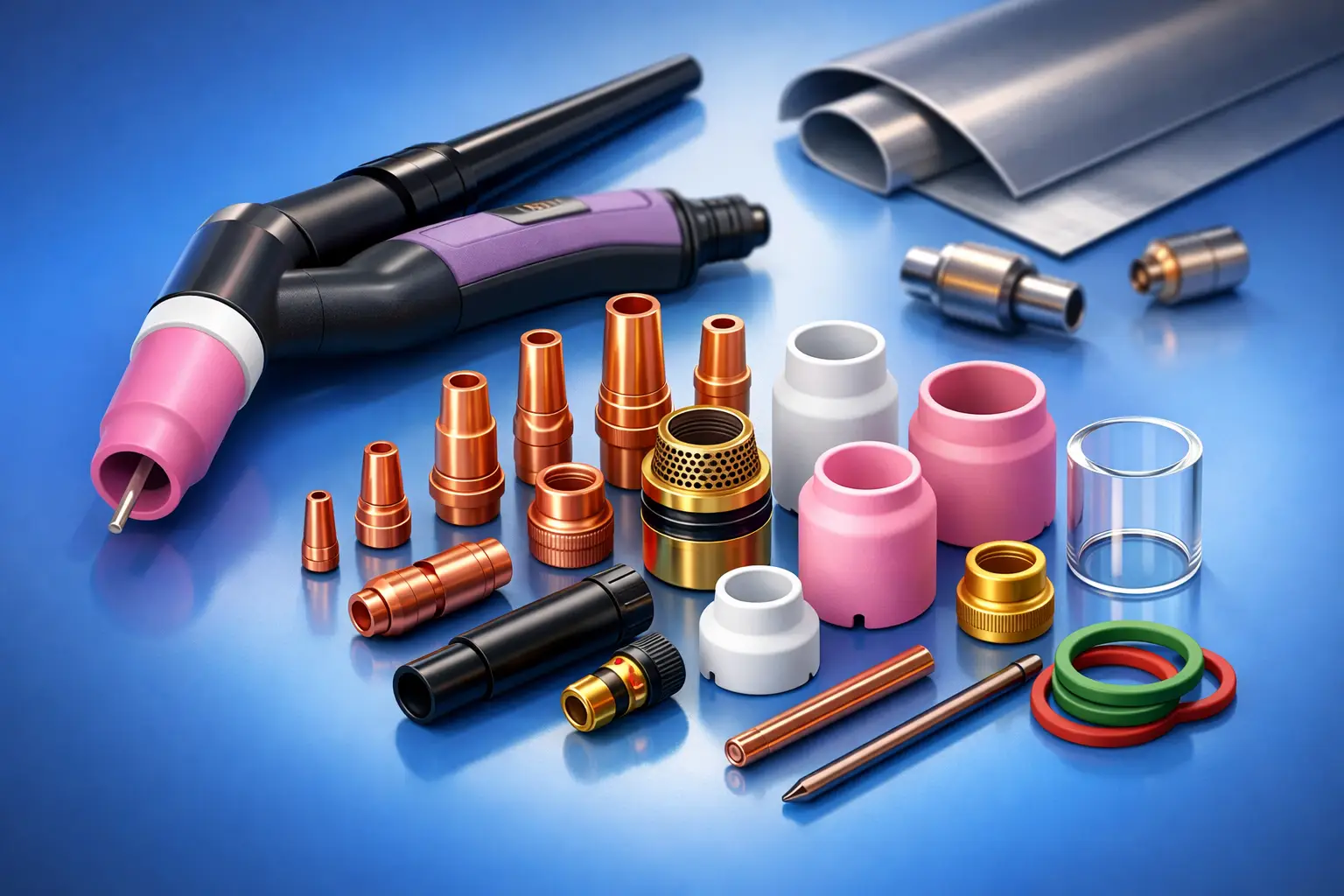
A TIG set-up can look fine on the bench and still weld badly once the consumables start wearing out. That is why TIG torch spare parts are not just small add-ons. They directly affect arc stability, shielding gas coverage, tungsten stick-out, heat control and how often a job gets stopped halfway through.
If you are running a fabrication shop, maintaining plant, teaching apprentices or simply trying to keep a torch working properly on site, the right parts save time and money. The wrong ones do the opposite. A cheap collet body with poor tolerances, a cracked ceramic cup or an ill-fitting back cap can turn a sound machine into a frustrating one very quickly.
Which TIG torch spare parts wear out first?
Most torches do not fail all at once. Performance usually drops off bit by bit, and it often starts with the parts nearest the arc. Ceramics crack, collets lose grip, collet bodies carbon up, and back caps get damaged from knocks or heat. O-rings and insulators can also perish over time, especially in busy workshops where torches are stripped and rebuilt regularly.
Gas lenses deserve a mention here as well. They are excellent for improving gas flow and helping with cleaner welds, especially on stainless and thin material, but they are still consumable components. Once the mesh is contaminated or physically damaged, shielding suffers and so does weld appearance.
On water-cooled torches, hoses and fittings are another point to watch. A minor issue in a water line can become a much bigger problem if it is ignored. Air-cooled torches are simpler, but they still depend on the same basic wear parts being in good order.
Why torch consumables make such a difference
There is a tendency to focus on the power source and forget the business end of the process. In reality, the torch assembly has a huge influence on day-to-day welding quality. TIG is less forgiving than some other processes. Small inconsistencies in fit, gas coverage or tungsten positioning show up quickly in the weld pool.
A worn collet may not hold the tungsten centrally. That can make arc control feel vague and inconsistent. A damaged nozzle can disturb shielding gas and increase the chance of contamination. Even a simple back cap issue can affect how securely the tungsten sits during longer runs.
This is where decent spare parts pay for themselves. You are not only replacing what is broken. You are restoring how the torch was meant to perform. For production work, coded work or fine-detail welding, that matters a lot.
TIG torch spare parts and compatibility
Compatibility is where many buyers get caught out. Not all TIG torch spare parts are interchangeable, even when they look similar at first glance. Torch series, head style, cooling type and brand all matter. A WP17, WP18 and WP26 family may share some common consumables in certain configurations, but not everything crosses over neatly.
It also depends on whether you are using standard consumables or a gas lens set-up. A standard collet body and a gas lens body are not the same thing, and the ceramic required can differ too. If you order one part in isolation without checking the full stack-up, you can end up with components that physically fit but do not work properly together.
That is why part identification matters. Ideally, you want the torch model, the machine connection details and a clear idea of the consumable system already fitted. If you are buying for multiple bays or multiple welders, standardising where possible makes stock control much easier.
Common parts worth keeping in stock
For most workshops, it makes sense to keep the regularly used items on the shelf rather than ordering one piece at a time. Ceramics, collets, collet bodies, gas lenses, back caps and insulators are the obvious starting point. If your team uses different tungsten diameters depending on the job, stock the matching consumables for each size instead of trying to make one size do everything.
It is also worth keeping a close eye on torch heads, switch assemblies and hose sets if the torch gets heavy use. Those are not always the first parts to fail, but when they do, downtime becomes far more expensive.
How to spot when a part needs replacing
Some failures are obvious. A ceramic shatters, a cap thread strips, or a hose starts leaking. Others are less visible and easier to ignore. If weld quality becomes inconsistent, gas usage seems high, the tungsten drifts, or contamination starts appearing more often than usual, inspect the torch before blaming the machine or the operator.
A quick strip-down often tells the story. Look for heat discolouration, damaged threads, distorted collets, blocked gas lens mesh and worn seals. Check whether the tungsten sits straight and tight. If it does not, the problem is often in the collet or collet body rather than the tungsten itself.
This is especially relevant in training environments and shared workshops, where torches can take more abuse than anyone admits. Regular checks are far cheaper than repeated rework.
Cheap parts versus dependable parts
Price matters. Every buyer in the trade knows that. But with TIG torch spares, the cheapest option is not always the best value. Tolerance, material quality and consistency all count. Poorly made parts can create fitting issues, inconsistent gas flow and shorter service life, which means you buy again sooner and lose time in the process.
That does not mean every job needs the most expensive component available. It depends on the work. For light occasional use, a lower-cost replacement may be perfectly acceptable. For coded welding, repeated stainless work, production environments or critical repair jobs, better-quality parts tend to justify themselves quickly.
The sensible approach is to match the spare to the application. If the torch earns its keep every day, buy parts that can stand up to it. That is usually the cheaper route over time.
Choosing parts for different welding jobs
Different materials and joint conditions put different demands on the torch. Stainless and aluminium work often benefit from cleaner, more stable gas coverage, which is one reason gas lens consumables are so widely used. Tight access joints may call for smaller cups or shorter back caps. Higher amperage work may need components that cope better with heat and longer duty cycles.
That is why there is no single best consumable set-up for every welder. The right choice depends on amperage, access, material type, finish requirement and whether the torch is air-cooled or water-cooled. A workshop doing thin stainless tube work will not necessarily stock the same configuration as a maintenance team repairing heavy section on site.
If you are buying for a team, it helps to think beyond the individual spare part and look at how the torch is actually being used. That gives you a better chance of ordering the right combination first time.
Buying TIG torch spare parts without wasting time
The fastest way to buy correctly is to work from the torch type and the complete consumable arrangement already in use. Guessing from a photo usually ends badly. If there is any doubt, remove the existing parts, check dimensions, and confirm whether the torch is running standard consumables or gas lenses.
It also helps to buy with uptime in mind. Ordering a single ceramic because one has cracked is false economy if the collet and body are also worn. Rebuilding the front end properly often saves a second stoppage a few days later.
For trade buyers, stock planning matters as much as the individual purchase. If you know which torch models are used across the workshop, keeping a practical range of matching spares avoids hold-ups and panic ordering. That is where a specialist supplier with real product knowledge makes life easier. Businesses such as Linc-Weld are built around that kind of support – not just shifting boxes, but helping customers get the right parts quickly.
When a torch needs more than spare parts
Sometimes replacing consumables will not solve the problem. If the torch body is damaged, the cable assembly is failing, or the machine connection is worn, it may be more sensible to replace the torch or book a repair rather than keep patching it up. There is a point where repeated small fixes cost more than sorting the underlying issue properly.
That decision depends on the age of the torch, how hard it is worked and whether replacement parts are still readily available. For many professional users, keeping one main torch and one ready spare is the practical answer. It reduces downtime and gives you breathing room when repairs are needed.
The small parts on a TIG torch do a big job. Keep them right, and the whole process feels cleaner, steadier and more predictable. Leave them too long, and the weld tells on you before the torch does.