Best Welding Pliers UK Welders Can Buy

A MIG torch can be running perfectly one minute and feeding badly the next because a nozzle is packed with spatter, a contact tip is damaged or the wire has been cut poorly. That is why the best welding pliers UK welders buy are not an optional extra in the torch case. They are a working tool for keeping a MIG setup clean, safe and productive between runs.
A proper pair combines several jobs in one hand tool: nozzle removal, nozzle reaming, wire cutting, tip removal and light hammering. The right choice saves time at the bench and prevents the familiar frustration of trying to remove a hot, spattered nozzle with ordinary combination pliers. For fabrication shops, maintenance teams and regular MIG users, buying on build quality and fit is worth far more than choosing the cheapest multi-tool on the shelf.
What makes the best welding pliers in the UK?
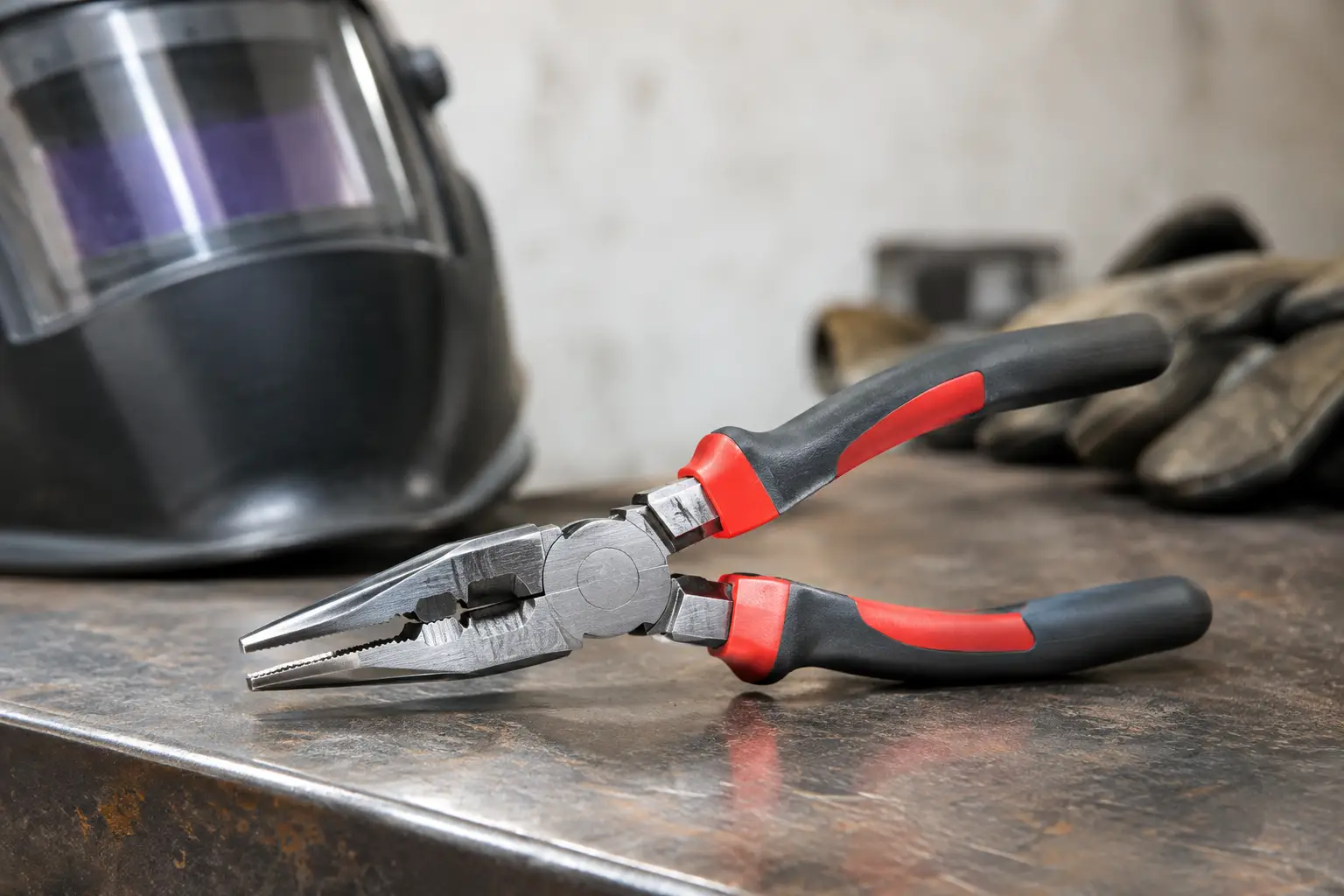
Welding pliers are designed around the consumables found on a MIG torch. Their jaws are shaped to grip a gas nozzle without crushing it, while the pointed section and reaming profile clear spatter from inside the nozzle. Most also include a cutting edge for MIG wire and an insulated grip for control around a warm torch.
The best pair is not automatically the heaviest. It needs to feel positive in the hand, open and close cleanly, and have jaws that line up properly. Sloppy pivots, poorly ground cutters and thin handles become obvious very quickly when the tool is used several times a shift.
For professional use, look for hardened steel construction, a strong riveted pivot, cleanly machined cutting edges and comfortable dipped or insulated handles. A corrosion-resistant finish is useful in mobile vans, site boxes and workshops where tools are regularly exposed to moisture, grinding dust and anti-spatter compound.
Nozzle grip and spatter removal matter most
The key feature is the shaped jaw. It should grip common MIG nozzles firmly enough to remove them from the torch, but without marking or deforming the brass or copper. Some pliers use a wider curved jaw that suits standard cylindrical nozzles particularly well; others are more compact and work better where access around the torch neck is restricted.
The reaming section should remove loose spatter efficiently. It is not a substitute for replacing a badly contaminated nozzle, but it makes routine maintenance quicker and helps maintain consistent shielding-gas coverage. A nozzle that is partially blocked or distorted can contribute to porosity, poor gas shielding and unnecessary clean-up on the weld.
Wire cutters should cut cleanly
A clean wire cut makes restriking easier and avoids leaving a long, hooked end that catches on the workpiece or interferes with the start of the weld. Quality welding pliers cut standard mild steel MIG wire cleanly when the edge is sharp and the handles have enough leverage.
Do not expect one pair of welding pliers to replace dedicated side cutters for every material. Stainless wire, hardfacing wire and heavier wire diameters place more demand on the cutter. If your team is cutting wire constantly, keep suitable side cutters alongside the MIG pliers and use each tool for its intended job.
Choosing welding pliers for your work
The best option depends on how your MIG torch is used, not just the price ticket. A hobby welder making occasional repairs may be well served by a straightforward, good-quality general-purpose pair. A production fabricator, by contrast, needs a tool that can take repeated nozzle changes and spatter cleaning without developing play at the joint.
For fabrication workshops
Workshop welders should prioritise durability and consistent jaw alignment. The tool will likely sit at the welding bay all day, used by more than one person and occasionally dropped on a concrete floor. A heavier professional-grade pair is usually the sensible buy here, even if it costs more initially.
Consider the consumables used on your torches. Standard MB-style consumables and larger industrial torch nozzles may need a wider jaw opening than smaller hobby torches. Check that the pliers can grip your usual nozzle shape before standardising across the workshop.
For mobile repair and site work
For mobile welders, compactness and grip are as important as outright size. Pliers need to fit in a torch case or tool bag without adding unnecessary bulk, yet still give enough leverage to remove a nozzle that has tightened through heat cycles and spatter build-up.
Choose handles with a secure, non-slip coating, especially if the work involves gloves, outdoor conditions or oily plant equipment. Keep the tool clean and dry after use. A seized pivot is the last thing needed when a repair needs turning around quickly.
For apprentices and training bays
Training environments benefit from simple, well-built pliers rather than bargain tools with vague functions. Learners need to see the correct routine: isolate the machine where required, allow hot parts to cool, remove the nozzle correctly, inspect the contact tip and clear spatter without damaging the torch.
One decent pair at each MIG station encourages that routine. It also reduces the temptation to use grips, adjustable spanners or side cutters on components they were never intended to handle.
Features worth paying for
When comparing welding pliers, focus on the parts that affect daily use. Four details are especially worthwhile:
- Hardened cutting edges for a cleaner cut and longer service life.
- A firm, smooth pivot that does not loosen after regular use.
- Properly formed nozzle jaws that remove nozzles without excessive force.
- Comfortable insulated handles that remain secure with welding gloves.
A spring-loaded handle can be convenient for repetitive work, although it is a preference rather than a requirement. Some welders prefer a traditional non-sprung design because it is simpler, less likely to trap dirt and easier to control when wearing thicker gloves.
Avoid treating a welding plier as a heavy hammer, chisel or pry bar. Many designs include a flat hammer area for light taps, such as freeing loose spatter or seating a small component, but repeated heavy striking can damage the pivot or knock the jaws out of alignment. It is a maintenance tool first.
How to keep MIG pliers working properly
Good welding pliers should last, provided they are not left buried under swarf and spatter. Wipe the jaws after use, particularly after cleaning inside a nozzle. A small amount of suitable light lubricant at the pivot keeps the action smooth, but avoid leaving excess oil where it can collect grinding dust.
Inspect the cutters regularly. If they begin to crush wire rather than shear it, replacement is normally more economical than fighting with damaged edges. Also check the jaw faces for burrs. A burr can mark a nozzle or make it more difficult to get a controlled grip.
The pliers are only one part of torch maintenance. If spatter is building up unusually fast, investigate the cause. Poor parameters, incorrect gas flow, unsuitable consumables, a contaminated liner or inconsistent technique can all create more torch maintenance than should be necessary. Keeping spare contact tips, nozzles, diffusers and anti-spatter products close to the welding bay prevents small issues becoming downtime.
Are expensive welding pliers always better?
Not always. A higher price does not guarantee that a pair suits every torch or every hand. However, very cheap pliers often reveal their limits through poor cutter performance, loose pivots and jaw shapes that do little more than resemble the proper tool.
For occasional light work, a sensible mid-range pair can be excellent value. For fabrication, maintenance and training departments, professional-grade pliers are normally the lower-cost choice over time because they stay accurate and usable for longer. Buy for the workload, the torch consumables in use and the level of support your operation needs.
At Linc-Weld, the practical view is straightforward: keep a dependable pair of welding pliers at every MIG station, use them as part of a regular torch-care routine and replace worn consumables before weld quality suffers. It is a small tool that helps keep the whole welding job moving.