
Welding Tables That Earn Their Floor Space

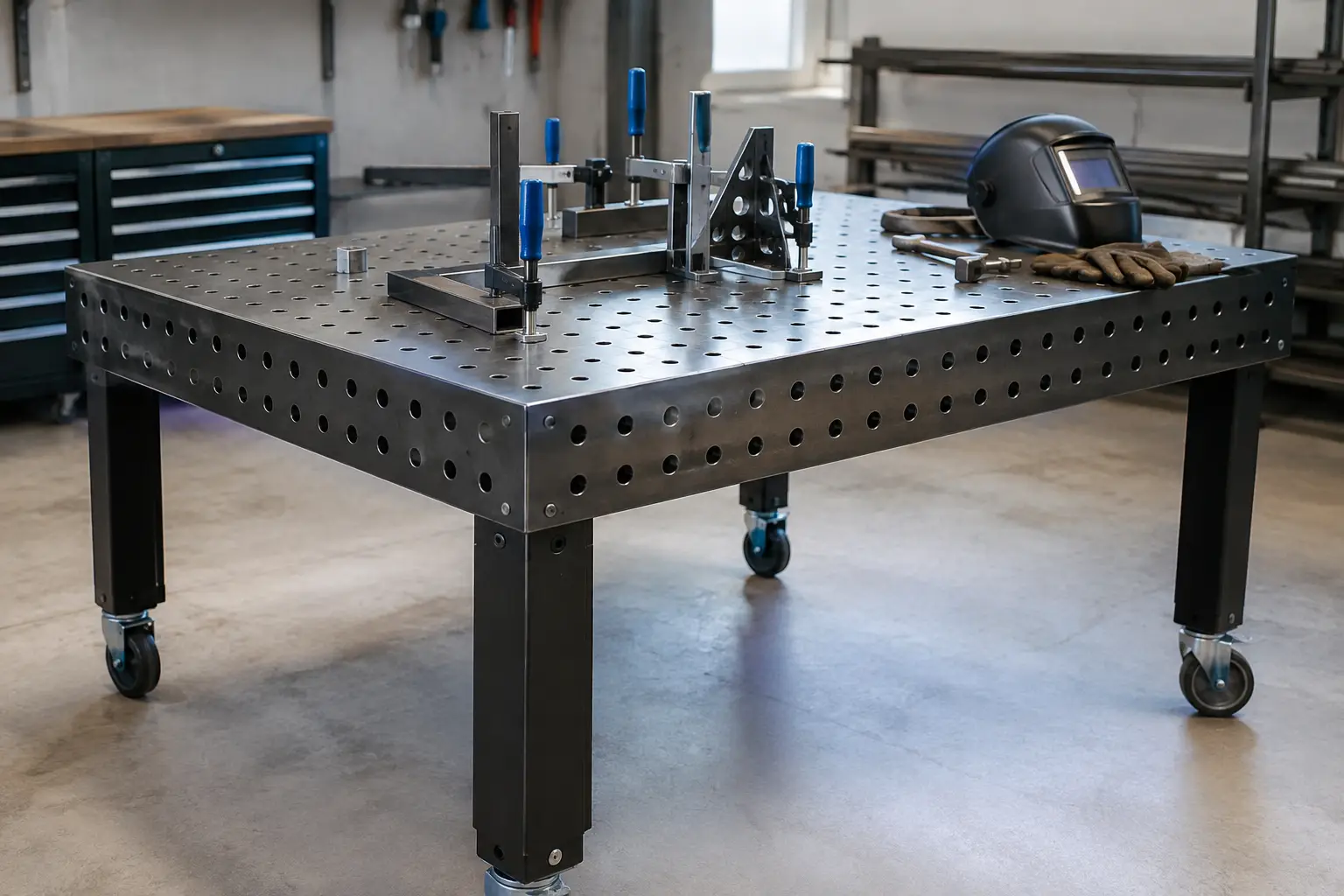
A welding table is not just somewhere to put a job. It is the reference surface for every tack, clamp, square check and assembly decision that follows. Good welding tables reduce rework before the arc is even struck. Poor ones leave you fighting distortion, chasing measurements and trying to fixture parts on a surface that has already bowed from its last hard day.
For a fabrication shop, maintenance department or college workshop, the right table pays for itself in faster set-up and more repeatable work. The key is matching the table to the jobs you actually produce, not buying the heaviest-looking option and hoping it covers every application.
What Good Welding Tables Need to Do
A proper welding table has three jobs: support the work safely, hold components in position and give the welder a dependable reference plane. Those requirements sound simple, but the details make a major difference when you are producing gates, frames, brackets, machinery repairs or repeat production assemblies.
Flatness matters because a table is only useful as a datum if it stays consistent. A light bench may be perfectly acceptable for occasional repair work, but it can flex when heavy fabrications are clamped down or when lifting equipment is used to position a job. Once a surface is distorted, you can still weld on it, but you cannot confidently build square work from it.
Fixture capability is just as important. A solid flat plate gives you a durable worktop, but a table with a hole grid, stops and compatible clamps gives you a system. It lets a fabricator locate parts quickly, hold angles accurately and repeat the same set-up without measuring from scratch every time.
Heat resistance also deserves attention. Welding spatter, pre-heated components and repeated thermal cycles take their toll. A table does not need to remain cosmetically perfect, but it must be thick and stable enough to tolerate normal workshop abuse without becoming uneven.
Welding Tables: Plate Top or Modular Fixture System?
The best choice depends on how often you need accurate, repeatable set-ups.
A traditional steel plate table is the straightforward option for general fabrication. It is hard-wearing, uncomplicated and gives plenty of uninterrupted surface area for awkward repairs, larger fabrications and jobs that do not suit a fixed hole pattern. For workshops handling varied one-off work, a heavy plate-top bench can be a sound investment. Add a vice, a few strong clamps and sensible storage underneath, and it becomes the centre of day-to-day production.
The trade-off is set-up time. Without a grid of holes and dedicated stops, every frame and bracket needs to be measured, clamped and checked independently. That is manageable for one-off fabrication, but it becomes slow when the same components are being made repeatedly.
Modular fixture tables use a regular hole pattern, normally designed around a specific diameter and grid spacing. Accessories such as locating pins, adjustable stops, squares, clamps and angle blocks lock into the holes to build a set-up around the component. This makes them particularly useful for railings, chassis parts, brackets, jigs and batch work where consistency matters.
They do cost more than a plain bench, especially once fixtures are added. They also demand discipline: keep holes clear of spatter, return clamps and tools to their place, and avoid buying accessories that do not match the table system. But for a busy fabrication business, the saving in layout and checking time can be substantial.
Choose the Table Size Around Your Real Work
A common mistake is buying too small because the table needs to fit a convenient corner. A small table is useful for brackets and repair work, but it soon becomes frustrating when a fabricated frame overhangs every side and there is nowhere sensible to clamp it.
Start by looking at the largest work you regularly fabricate, then consider the space needed around it for the welder, clamps and material handling. You do not always need a table as large as the finished job. In many cases, a good fixture table can be extended with supports, outriggers or a second table. However, the primary surface should comfortably carry the main assembly without forcing unsafe or awkward working positions.
Height is equally practical. A table that is too low encourages poor posture and puts the welder in the line of spatter. One that is too high makes it harder to apply body weight when clamping or to reach across a larger job. Adjustable legs are useful where several people share the work area, where floors are uneven or where tables must be levelled accurately together.
Do not forget access. If forklifts, pallet trucks or lifting gear are used, consider where the legs sit and whether a load can be positioned without damaging the table or trapping the operator. A table needs to work with the workshop flow, not obstruct it.
Thickness, Load Capacity and Construction
Steel thickness should suit the workload. Light sheet and small brackets do not need the same table as structural fabrications, heavy plant repairs or high-volume jig work. Thicker tops resist local denting and heat movement better, but they add weight and cost. The strongest option is not automatically the most productive if it cannot be moved, repositioned or integrated into the space available.
Look beyond the top plate. A well-built frame, braced legs and quality levelling feet are what keep the working surface stable under load. If a table rocks when a clamp is tightened, it will waste time and undermine accuracy. For mobile workstations, lockable heavy-duty castors are worthwhile, but only if the table remains rigid once parked.
Check the stated loading capacity and treat it realistically. The load includes not only the fabricated item but also fixtures, clamps, lifting forces and the occasional component that gets dropped onto the top. If you are regularly working with heavy fabrications, choose a table with the margin to handle them safely rather than operating at its limit.
The Fixtures Matter as Much as the Table
A fixture table without the right clamps is an expensive flat surface with holes in it. Before choosing a system, check the range of compatible accessories and buy the core pieces needed for your work.
For most fabrication bays, that means a sensible mix of locating pins, threaded adapters, quick-action clamps, adjustable stops, angle squares and magnetic or mechanical holders. Mechanical location is generally more reliable than relying on magnets alone, particularly where accurate angles and repeated production are involved. Magnets have their place for quick tacks and light holding duties, but they can collect spatter and are not a substitute for positive clamping.
Think about the shape of your work. Tube and box section benefit from V-blocks, adjustable stops and right-angle fixtures. Flat plate may need low-profile clamps that keep the weld area clear. Complex assemblies often justify a dedicated jig, especially when the same job returns every week.
Compatibility matters. Hole diameter, table grid and fixture design vary between systems. Buying a cheap collection of mismatched accessories can quickly create more problems than it solves. Choose a system with available replacement parts and enough accessories to expand as your workload grows.
Set Up for Welding, Not Just Assembly
A neat fixture is only useful if the weld can be made safely and without constant repositioning. Leave room for the torch angle, electrode holder or TIG torch, and plan where the work return clamp will attach. Poor return placement can force current through bearings, hinges or sensitive components, which is a risk no workshop needs.
Keep combustible items away from the table and manage leads so they do not become trip hazards around the job. If grinding takes place at the same station, remove swarf and spatter from holes and surfaces regularly. A fixture pin that will not seat properly can put an assembly out of position before welding begins.
Distortion still needs managing, even on the best table. Clamp enough to hold alignment, but do not assume clamping alone defeats heat movement. Use a sensible tack sequence, balance welds where possible and let the fabrication cool in a controlled way when accuracy is critical. The table provides the reference. Good welding practice keeps the work close to it.
When a Basic Bench Is the Better Buy
Not every workshop needs a premium fixture system. For mobile repair work, occasional maintenance tasks, agricultural repairs or a small unit with limited floor space, a conventional steel welding bench may be the better value choice. Spend the difference on a dependable welding machine, extraction, quality PPE and the consumables that keep work moving.
The same applies to jobs that are too large or irregular for a standard table. Heavy gates, site repairs and structural pieces often need trestles, positioners or purpose-built supports rather than forcing everything onto one bench. The aim is safe, controlled fabrication, not using a table for work it was never designed to carry.
For regular fabrication, training bays and production work, however, accuracy soon becomes a commercial issue. Fewer measuring errors, quicker tacking and repeatable jigs mean more than a tidier workshop. They mean less time correcting avoidable mistakes.
A welding table should earn its floor space every shift. Choose one that suits your process, material sizes and fixture needs, then keep it level, clean and properly equipped. That gives the welder a dependable starting point – and gives every finished job a better chance of leaving the workshop right first time.