
What Size MIG Wire? A Practical Guide for UK Welders

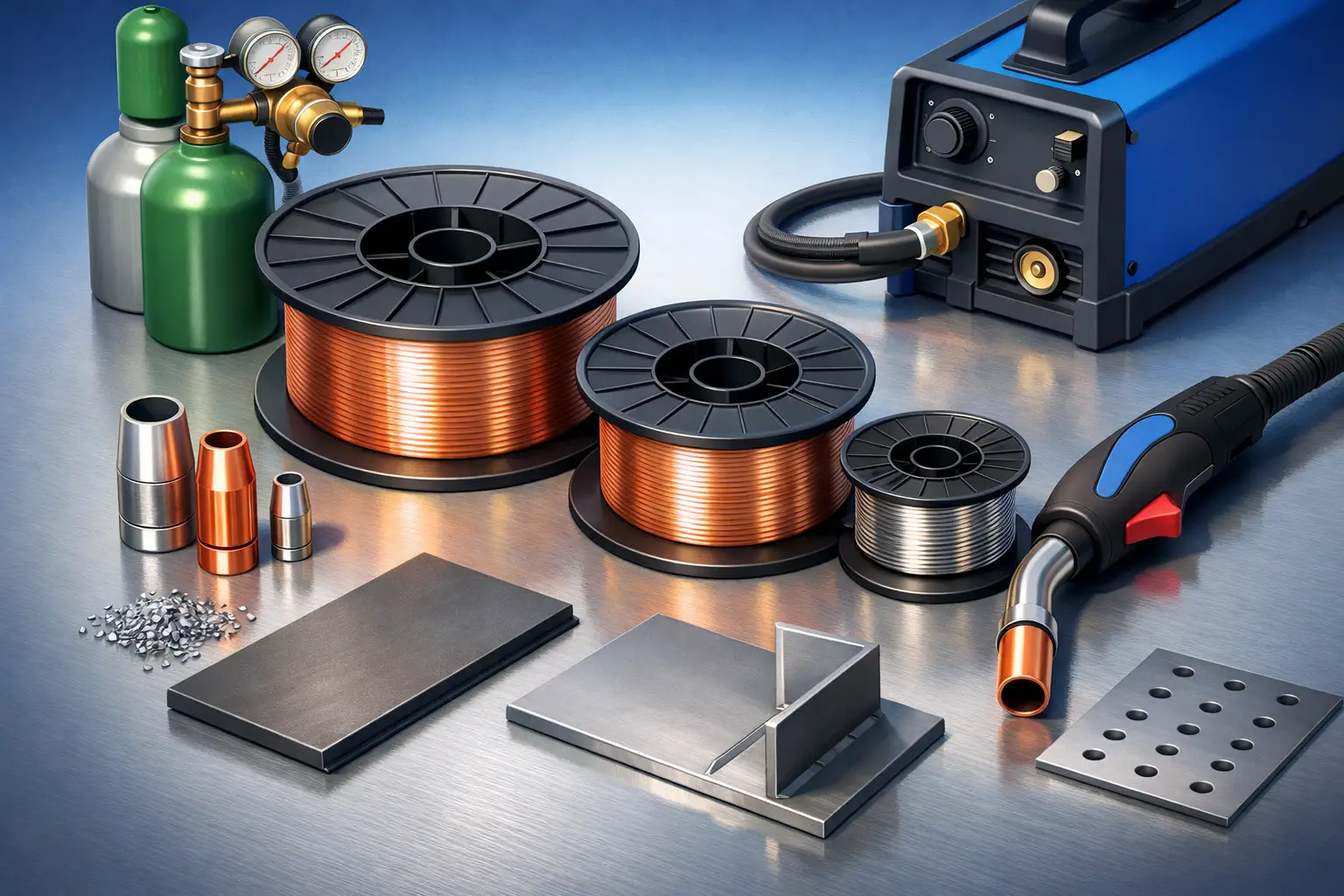
A 0.8mm reel is not automatically the right answer just because it is the most common one on the shelf. Ask what size MIG wire you need before loading the machine, and you can avoid poor fusion, excess spatter, burn-through and wasted time grinding out a bad run. The right diameter depends on material thickness, joint design, welding position, machine output and the finish the job demands.
What size MIG wire should you use?
For most mild steel fabrication, 0.8mm solid MIG wire is the dependable all-round choice. It suits a wide range of workshop work, from general brackets and box section to medium-thickness plate, and it runs well on the majority of professional MIG sets.
That said, there is no one-size answer. A bodywork repair, a farm gate, a structural frame and a high-output production weld all need different priorities. Fine wire gives more control at lower amps. Thicker wire carries more current and deposits more weld metal, but it needs enough power and material thickness to earn its place.
Use this as a practical starting point for mild steel solid wire:
| Material and typical work | Starting wire diameter | Why it suits the job | | — | — | — | | Thin sheet, vehicle repair and light fabrication | 0.6mm | Better low-amp control and less risk of blowing through | | General fabrication, box section and everyday workshop repairs | 0.8mm | The best balance of control, penetration and availability | | Heavier sections, fillets and higher-output fabrication | 0.9mm | Higher deposition with good penetration where the set has enough power | | Thick plate and larger structural work | 1.0mm or 1.2mm | Built for higher current, larger welds and longer runs |
These are starting points, not a replacement for a qualified welding procedure. If you are working to a WPS, coded standard or customer specification, follow the approved procedure first. In production work, changing wire diameter can affect the qualified parameters, heat input and finished weld properties.
0.6mm MIG wire for thin steel
Choose 0.6mm solid wire when the main concern is controlling heat on thin material. It is a strong option for car panels, exhaust work, cabinets, light brackets and sheet steel around 0.8mm to 2mm, depending on the joint and fit-up.
Because the wire needs less current to run properly, it gives smaller weld pools and more scope to make short, controlled welds. That matters when a panel has little room for error. It will not make poor preparation disappear, though. A tight joint, clean steel and sensible tack spacing still do most of the work in preventing distortion and burn-through.
The trade-off is deposition rate. On 5mm plate or a substantial fillet weld, 0.6mm wire can feel slow and may not deliver the penetration profile you need. Trying to force fine wire into a heavy job usually means an unstable setup or a weld that looks acceptable on the surface but lacks fusion at the root or toes.
0.8mm MIG wire for everyday fabrication
For many UK workshops, 0.8mm is the reel to keep on the machine. It covers a broad working range, handles general mild steel fabrication well and is available in practical reel sizes for site, maintenance and shop use.
It is particularly useful on material from roughly 2mm upwards, including box section, angle, plate, gates, frames and repair work. With the right gas and machine settings, it can still be used successfully on thinner material, although a 0.6mm wire may offer a better margin of control where burn-through is a genuine risk.
If you only run one size of solid mild steel wire on a general-purpose MIG set, 0.8mm is usually the sensible stock choice. It is not a compromise in a negative sense. It is the working standard because it gives dependable results across so many common jobs.
0.9mm and 1.0mm wire for heavier work
When section thickness rises and weld volume matters, move up to 0.9mm or 1.0mm wire. These diameters are better suited to larger fillet welds, heavier plate, fabrication benches, structural assemblies and repetitive work where deposition rate affects productivity.
Thicker wire can carry higher current without becoming unstable, helping you put more metal into the joint in less time. It can also suit a spray-transfer-capable machine and an argon-rich shielding gas on suitable material. This is where machine capability matters. A compact MIG set that performs well with 0.6mm and 0.8mm wire may not have the output or duty cycle to make 1.0mm wire worthwhile.
Do not select a bigger wire purely because the steel is thick. Joint preparation, access, welding position and the required penetration all count. A properly prepared multi-pass weld using 0.8mm or 0.9mm wire can be the better option where access is limited or the machine is not designed for sustained high-current work.
Match the wire to your machine and setup
Wire diameter is only one part of the system. The wire, contact tip, liner, drive rolls, gas and settings need to match. A quality reel will not perform properly if it is being pushed through the wrong liner or fed by worn rollers.
Fit a contact tip that matches the wire size. Running 0.8mm wire through a badly worn or oversized tip can give an erratic arc, poor starts and inconsistent current transfer. Equally, forcing larger wire through a small tip creates feeding problems and can cause the wire to bind.
For solid steel wire, use the correct V-groove drive roll and set only enough pressure to feed consistently. Crushing the wire with excessive roller tension creates shavings, contaminates the liner and causes the very bird-nesting problems people often blame on the wire reel. For flux-cored wire, knurled drive rolls are normally required. Aluminium wire needs U-groove rolls, a suitable liner and a setup designed to feed soft wire without damage.
Your machine manual will state the supported wire range. Check it before ordering 1.0mm or 1.2mm wire, especially on smaller inverter MIG machines. Also check reel compatibility. A 15kg industrial reel is good value for regular workshop use, but it is no use if the machine only accepts compact 5kg spools without an adaptor.
Gas choice changes how the wire behaves
Solid mild steel MIG wire is commonly used with an argon and CO2 mix. A mixed gas generally gives a smoother arc, cleaner bead appearance and lower spatter than straight CO2. That makes it a practical choice for fabrication where finishing time costs money.
Straight CO2 remains a workable and economical option for certain repair and site jobs, but it tends to run hotter and produce more spatter. If your weld is harsh, dirty or difficult to control, do not assume changing wire size is the answer. Check the gas type, flow rate, leaks, torch condition and polarity before changing consumables.
Stainless and aluminium need their own matching wire grades and shielding gases. Do not use ordinary mild steel wire on stainless because it is what happens to be loaded in the feeder. For stainless work, select the filler to suit the parent material and service conditions. For aluminium, use the correct alloy wire and make sure the torch and feed system are set up for it.
Solid wire versus flux-cored wire
The question is sometimes not what size MIG wire, but whether solid MIG wire is the right consumable at all. Solid wire with shielding gas is ideal for clean, controlled indoor welding. It is the normal choice for workshop fabrication, repair and production work.
Self-shielded flux-cored wire is useful outdoors or where carrying a gas bottle is impractical. It produces its own shielding, but it usually creates more fumes, more slag and a rougher finish. Common flux-cored sizes such as 0.9mm are not directly comparable with 0.9mm solid wire. They need different polarity, feed rolls and settings, so never copy your solid-wire setup without checking the wire manufacturer guidance.
Gas-shielded flux-cored wire has a place in higher-deposition industrial work, but it is a specialist choice rather than a shortcut for general MIG welding. Choose it for the procedure and productivity requirement, not because the reel looks similar.
Signs your MIG wire size is wrong
A wire size mismatch usually shows itself at the torch. If you are trying to weld thin sheet with a wire that is too heavy for the available low-end control, you may see an aggressive arc, a large weld pool and repeated burn-through. If the wire is too fine for a heavy joint, you may find yourself travelling painfully slowly, building excessive bead reinforcement or struggling to achieve sound fusion.
Before swapping reels, rule out the basics. Clean the material back to bright metal, check the earth clamp, confirm the polarity, inspect the tip and liner, and make sure gas is reaching the weld pool. Poor wire feeding can look like a setting issue, while poor fit-up can look like a penetration issue.
Make a few test welds on offcuts of the same thickness and joint type. Cut and inspect a sample if the weld is safety-critical or production work. The bead should not just look tidy – it should tie in cleanly at both edges and suit the job’s strength requirement.
For dependable results, keep 0.6mm wire for thin sheet, 0.8mm for everyday fabrication and heavier diameters for machines and jobs that can genuinely use them. If the application is unusual, bring the material thickness, joint details and machine model to Linc-Weld and get the consumable choice sorted before the job reaches the bench.