Is Investing in a Cobot Welding System Worth It?

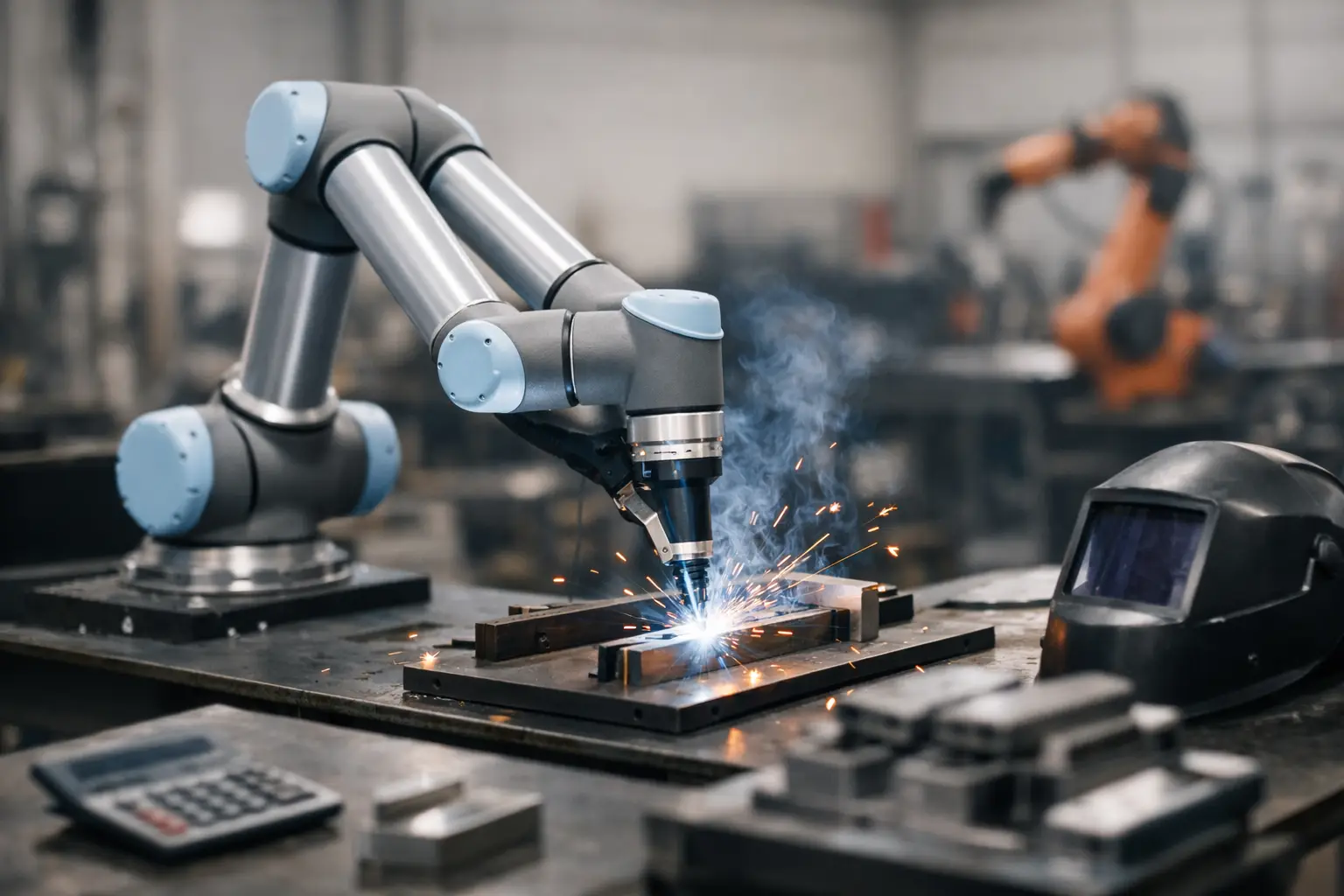
A cobot that produces the same clean fillet weld all day can transform a busy fabrication bay. It can also become an expensive piece of kit waiting for work if the parts, fixtures and programme are not right. So, is a cobot robot welder purchase worth it? For the right workshop, absolutely. For a business with highly variable one-off work and no time to prepare jobs properly, it may not be the first investment to make.
What a cobot welder actually buys you
A collaborative welding robot is not simply a faster MIG set with an arm attached. Its real value is consistency. Once a weld path, parameters and fixture are proven, the cobot can repeat the job with far less variation than manual welding across a long production run.
That means more predictable bead profile, fewer reworks, steadier travel speed and better control of heat input. On repetitive brackets, frames, guards, handrails or production assemblies, those gains can reduce the cost per part even where the cobot is not physically welding at maximum speed.
The other major benefit is labour deployment. Skilled welders are difficult to recruit and even harder to replace. A cobot does not remove the need for a competent welder or fabricator. It frees that person from feeding the same repetitive welds all shift, allowing them to focus on fit-up, complex joints, inspection, repair work and higher-value fabrication.
Is a cobot robot welder purchase worth it for your workload?
The strongest case is repeatability. If you regularly make the same parts in batches, a cobot is worth serious consideration. A batch does not have to run into the thousands. Regular weekly or monthly work can justify automation where each part has enough welding time and the set-up can be retained or quickly repeated.
Look closely at the jobs currently causing delays. A cobot suits welds that are accessible, stable and repeatable, with consistent component position. It is particularly useful where operators are spending hours on straightforward MIG welding that follows the same route every time.
It is less convincing for constantly changing repair work, oversized assemblies that are difficult to present to the robot, or jobs with poor fit-up. A cobot will repeat what it is taught, including a poor process. If gaps vary wildly, components distort or parts arrive inconsistently cut, the real issue may be upstream fabrication control rather than welding capacity.
Before pricing a system, assess four practical points:
- How many hours a week are genuinely spent on repeatable welds?
- Can parts be located in a simple, repeatable fixture?
- Is there enough floor space for the cell, work handling and safe access?
- Who will programme, prove out and maintain the process?
If the answers are vague, gather the production data first. A short time study of welding, handling, tacking, rework and changeovers is more useful than guessing from monthly turnover.
Payback is more than an hourly welding rate
A common mistake is to calculate return on investment using only the welder’s hourly rate. That understates the value in some cases and overstates it in others. The proper calculation includes labour saved or redeployed, reduced rework, improved throughput, consumable use, overtime avoided and the margin on additional work the shop can now take on.
It must also include the full cost of ownership. Budget for the cobot, power source, torch package, wire feed arrangement, extraction, guarding or safety equipment where required, fixtures, installation, operator training and programming time. Depending on the system and application, positioners, tables or part-handling equipment may make the difference between a productive cell and a robot that spends more time waiting than welding.
Do not assume unattended operation either. Collaborative does not mean risk-free. Welding brings arc radiation, hot material, spatter, fumes and moving equipment into the equation. A proper risk assessment, suitable PPE, fume control and safe working procedure remain essential. In many applications, speed and reach settings, workpiece design and the surrounding environment will determine whether additional safeguarding is necessary.
The hidden make-or-break factor: fixturing
Good fixturing is often the best money spent in a cobot welding project. The robot needs the workpiece to be in the same place every time. A basic but rigid fixture with clear datum points can cut set-up time, improve joint location and prevent the programme from drifting out of tolerance.
This is where experienced fabricators have an advantage. They understand where parts pull during welding, where clamps must sit and which joints need a tack before the robot takes over. Build that knowledge into the fixture and programme rather than expecting the cobot to compensate for every variation.
For low-volume, mixed work, quick-change fixtures can improve the business case. The aim is not to automate every job in the workshop. It is to identify the repeat work that earns back the cell while manual welders handle the work that needs judgement and flexibility.
Buying the right system, not just the cheapest system
A lower purchase price is attractive, but a cobot package should be judged on application support as well as specification. Check payload, reach, torch access, welding process capability, programming interface, service response and consumable compatibility. Ask how demonstrations are run and whether your own sample parts can be assessed before you commit.
After-sales support matters because production does not stop politely when a torch, liner, feeder or programme needs attention. The supplier should be able to help with set-up, training, repair and ongoing welding equipment support, not simply drop a crate at the door.
For many UK fabrication shops, the best starting point is a live demonstration using real components, followed by a straightforward payback calculation based on actual batch sizes. Linc-Weld can help buyers look beyond the headline price and assess the machine, consumables, extraction and support needed to make a cobot earn its place on the shop floor.