Are Welding Fumes Hazardous? Practical UK Controls

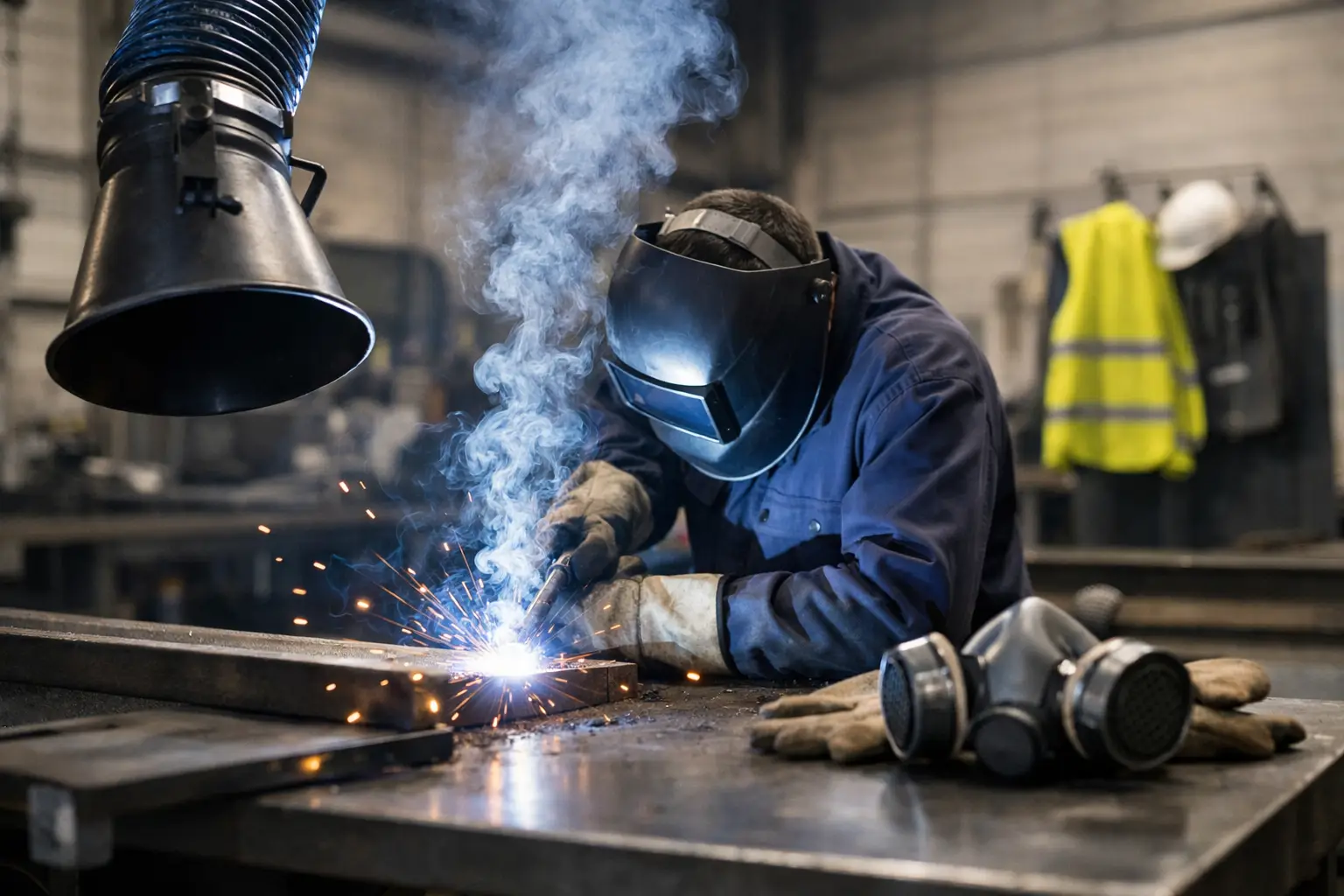
A clear view through the visor does not mean the air is safe. Are welding fumes hazardous? Yes. Welding fume is a hazardous substance, and breathing it in is a serious occupational health risk – whether you are running production MIG work all shift, carrying out a quick repair with MMA, or teaching students in a fabrication bay.
The right answer is not to panic or rely on a disposable mask at the last minute. It is to control fume at source, set the job up properly and use respiratory protection that suits the process, material and working environment. For professional workshops, this is as much about keeping skilled people fit for work as it is about meeting UK health and safety duties.
Why welding fumes are hazardous
Welding creates an airborne mixture of very fine particles and gases. The exact make-up changes with the parent metal, filler wire or electrode, coating, shielding gas, welding process and contaminants on the workpiece. Because many particles are small enough to travel deep into the lungs, a visible plume is not a reliable measure of exposure.
Fume can contain metal oxides from steel, stainless steel, aluminium and other alloys. Depending on the task, it may also contain manganese, chromium, nickel, zinc, lead or cadmium. Stainless steel work deserves particular attention because chromium and nickel compounds can present significant health risks. Galvanised steel can produce zinc oxide fume, while painted, plated, oily or solvent-contaminated material adds another layer of hazard.
Short-term exposure can irritate the eyes, nose and throat, cause coughing, chest tightness and headaches, or leave a welder feeling rough after a shift. Metal fume fever is associated with zinc oxide exposure and can feel like flu. The bigger concern is repeated exposure over years. Welding fume is recognised as a cause of occupational lung cancer, and ongoing exposure may contribute to respiratory illness and neurological effects, particularly where manganese is involved.
That is why the question is not simply whether the smoke looks bad. If fume is being generated, it needs controlling.
Are welding fumes hazardous on every job?
The risk level depends on the job, but there is no sensible basis for treating routine welding fume as harmless. HSE guidance expects employers to control exposure from welding fume, including during outdoor work where natural ventilation can be unpredictable and the welder may still be standing in the plume.
MIG welding on mild steel in a well-designed booth may be easier to control than MMA welding inside a vessel, but both produce fume. TIG generally creates less visible particulate fume than many other processes, yet it can still create hazardous gases and the material being welded still matters. Plasma cutting, gouging and thermal cutting can also generate substantial airborne contaminants, especially on coated or painted steel.
Confined spaces, pits, tanks, ship sections and enclosed fabrication areas are higher-risk environments. Fume builds up quickly, extraction may be difficult to position and oxygen displacement or other atmospheric hazards may be present. These jobs require proper planning, suitable extraction, atmospheric monitoring where required and a competent confined-space procedure. A standard workshop mask is not a substitute for that control plan.
Start with control at source, not PPE
Under COSHH, the hierarchy of control matters. Respiratory protective equipment is essential in many welding applications, but it should support effective extraction rather than replace it. A welder wearing RPE in a cloud of fume is not a well-controlled process.
A practical workshop approach should cover these points:
- Choose cleaner preparation methods. Remove paint, oil, grease and coatings where the job allows. Never weld on unknown coatings without identifying the material and its hazards first.
- Use local exhaust ventilation. On-torch extraction, movable extraction arms, downdraught benches and enclosed booths capture fume close to where it is made. The hood needs to be positioned correctly and kept close enough to the arc to work.
- Keep the welder out of the plume. Adjust the bench height, job position and body position so fume travels away from the breathing zone. Do not lean over the weld simply because access is awkward.
- Maintain extraction properly. A system that sounds as though it is running may still have blocked filters, damaged ducting or poor capture. LEV must be examined and tested by a competent person at the required intervals, typically at least every 14 months.
- Select suitable RPE. Where residual exposure remains, use equipment with the right protection level for the task, fitted to the wearer and used correctly.
General workshop ventilation can make the space more comfortable, but it rarely provides reliable control on its own. Opening roller shutters in winter may also create draughts that pull fume straight through the welder’s breathing zone. Capture at source is the priority.
Extraction choice depends on the way you weld
A fabrication shop doing repeat MIG welds on benches may benefit from on-torch extraction or a fixed extraction arm at each bay. A maintenance team moving around a site may need portable fume extraction equipment that can be placed beside the job. For heavy, repetitive fabrication, a downdraught bench or purpose-designed booth can offer better consistency.
There is a trade-off. High extraction flow too close to the arc can affect shielding gas coverage and weld quality if the system is poorly specified or positioned. The answer is not to switch it off. It is to select equipment designed for the process, set it up correctly and prove that both fume control and weld performance are acceptable.
Choosing respiratory protection for welding fume
For many welders, powered air-purifying respirators integrated with a welding helmet provide a practical balance of protection and comfort. They supply filtered air to the headtop and are particularly useful for longer jobs, production work and situations where a disposable mask would be uncomfortable or difficult to keep sealed.
Reusable half masks and disposable filtering facepieces can be suitable for some tasks, but selection must be based on a risk assessment. A P3 particulate filter is commonly used for welding fume, yet the filter alone does not make the system suitable. Face fit, compatibility with eye and head protection, wear time, maintenance and the presence of gases or vapours all need consideration.
Tight-fitting RPE requires face-fit testing. Facial hair where the seal sits can prevent it working as intended. A powered helmet may be a better option for welders who cannot achieve a reliable seal, but it still needs the correct headtop, filters, battery checks, cleaning and user training.
Do not use air-purifying RPE where the atmosphere may be oxygen-deficient or where concentrations may be immediately dangerous to life or health. Those situations demand specialist assessment and, where appropriate, supplied-air breathing apparatus.
Materials and tasks that deserve extra caution
Treat unknown metal and coatings as a stop sign until they have been checked. A quick repair on old plant can involve lead paint, galvanising, chrome plating, residues from degreasers or contaminated oil. Hot work on drums, tanks or containers has additional fire, explosion and toxic atmosphere risks, even when the container looks empty.
Stainless steel, galvanised steel and painted structural steel should all trigger a more deliberate assessment. The same applies to welding in schools and colleges. Apprentices may be learning good habits, so extraction positioning, housekeeping and correct PPE should be built into every practical session rather than treated as an optional extra when the room gets smoky.
Supervisors should also watch for the jobs that become normalised. A five-minute tack weld in a corner, a mobile repair beside stored materials or a rushed cut before site handover can be exactly where controls are skipped. Exposure adds up across a working week.
Making fume control work on a real shop floor
The best control measures are the ones people can use without fighting the setup. Put extraction where work actually happens, not where the drawing says it should happen. Make sure flexible arms hold position, portable units are easy to move, replacement filters are available and welding bays are not used as general storage areas.
Training should be practical. Welders need to know how close to position an extraction hood, what a poor airflow looks like, when filters need changing and why a beard changes RPE options. Managers and buyers need to plan for maintenance, LEV testing and consumables rather than viewing them as an avoidable cost after the machine has been purchased.
Linc-Weld supports workshops with welding PPE, fume-control equipment and LEV testing, backed by technical advice that starts with the process being used rather than a one-size-fits-all product recommendation. The correct setup depends on the material, arc time, bay layout and whether the work is fixed, mobile or site-based.
Healthy welders are not an add-on to a productive workshop. Set up extraction before striking the arc, wear the right protection every time and deal with poor fume control while it is still a simple fix.