
Welding Clamps That Keep Fabrication Accurate

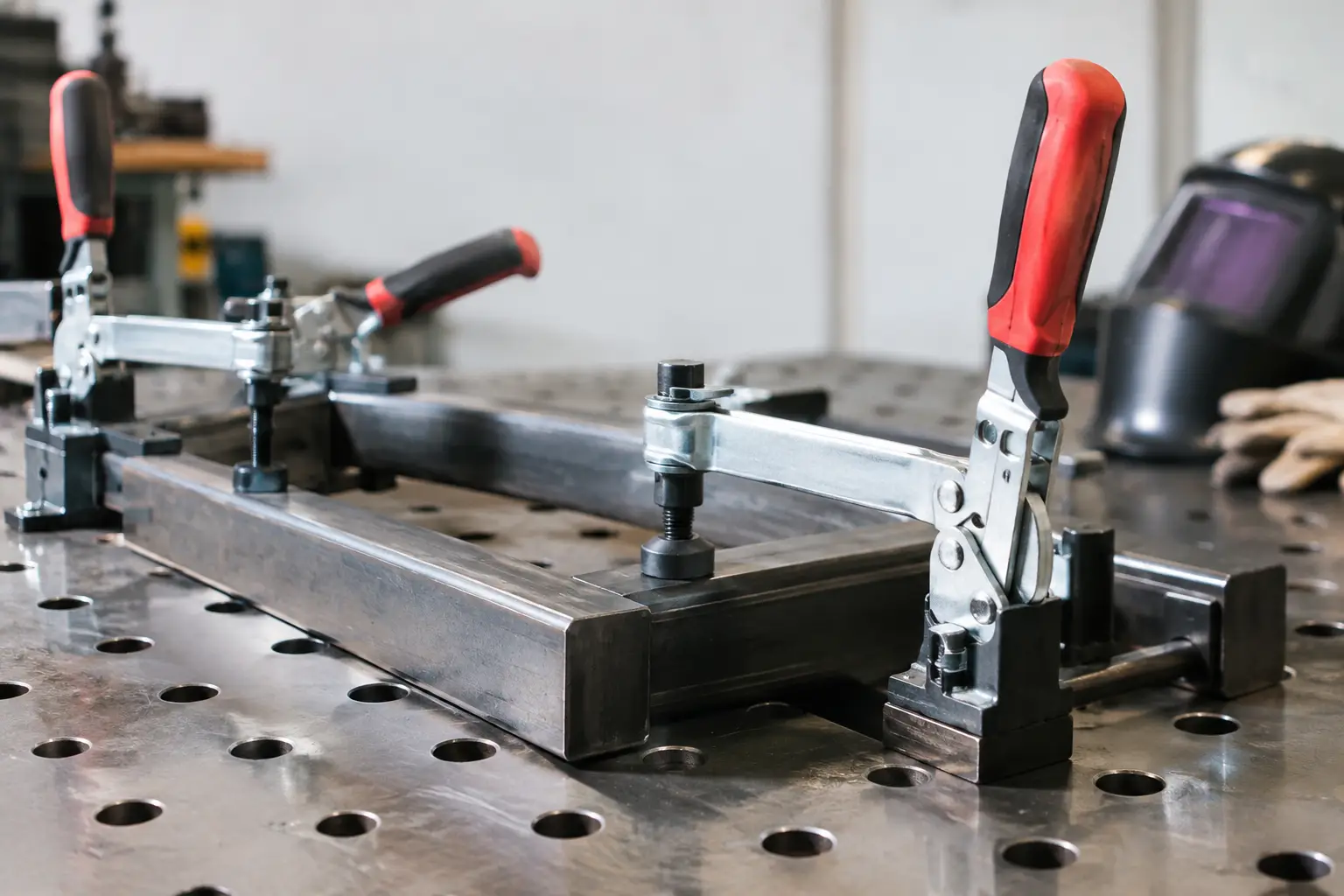
A weld can be sound, well-profiled and fully penetrated, yet the job can still be wrong if the parts moved before it cooled. Welding clamps are what keep a fabrication set-up honest: holding joints tight, maintaining squareness and giving the welder a repeatable starting point. Whether you are building gates, frames, brackets or production assemblies, the right clamp saves time otherwise spent pulling, grinding and reworking.
Why welding clamps earn their place on every bench
Clamps are not just an extra hand. They control fit-up, and fit-up controls weld quality. A gap that opens during tacking can leave a poor root profile; a frame allowed to creep out of square may need cutting apart after inspection. Good holding tools let you position the work, tack it with confidence and check measurements before committing to longer runs.
They also improve consistency where the same component is made repeatedly. Once a stop, magnet or fixture is set, the next part should land in the same position. That matters to busy fabrication shops, maintenance departments and colleges alike. Less marking out, fewer adjustments and more predictable results make a real difference across a shift.
There is a limit, though. No clamp can cancel the pull of a badly planned weld sequence. Heat still travels, weld metal still contracts and thin material still moves readily. The aim is to use clamping alongside correct tack placement, joint preparation and sequence control – not to force a distorted job into shape.
Choose welding clamps by the work, not the label
The most useful clamp is the one that reaches the joint, applies enough pressure and survives the environment. A light-duty toggle clamp may be ideal for a jig on thin sheet, but it is not the answer for pulling heavy structural sections together. Start with the material thickness, joint type and access around the weld.
G-clamps and F-clamps for straightforward holding
G-clamps are a workshop staple for a reason. Their rigid frame delivers concentrated pressure and makes them useful for holding plates, brackets and box section against a bench, backing bar or angle. Select throat depth carefully. A clamp that is strong but cannot reach the required position is no use when the workpiece is already set up.
F-clamps offer more reach and faster adjustment across wider assemblies. They are useful when aligning frames, holding temporary stops or closing a joint before tacking. Their longer bars can flex under high load, so use more than one clamp on larger work rather than expecting a single tool to keep everything flat.
For hot work, choose clamps built for welding conditions. Copper-plated spindles, heat-resistant handles and solid frames are practical upgrades, particularly where spatter and repeated heating are part of the day-to-day workload. Keep threads clean and lightly lubricated so the clamp tightens properly rather than binding when it matters.
Locking C-clamps for quick fit-up
Locking C-clamps are excellent for quick, one-handed positioning. The adjustment screw sets the opening, then the handle locks over centre to apply pressure. They are particularly useful on lap joints, sheet work, tabs and small assemblies where a conventional screw clamp would slow the set-up down.
Their trade-off is limited throat depth and opening capacity. They are best used close to an edge, not halfway across a wide panel. The release lever should remain accessible after tacking, and the clamp should be positioned clear of the torch angle. If it is in the way of the weld, it will either be moved too early or collect unnecessary spatter.
Welding magnets for angles and fast tacks
Magnetic welding holders are fast and convenient for 45°, 90° and 135° fit-ups. They are particularly handy for tacking small box section, angle and light plate when a full jig would be excessive. Adjustable magnetic squares give more flexibility, while switchable magnets make cleaning and removal easier.
Use them with judgement. Standard magnets collect grinding dust and ferrous debris, which can stop work sitting fully flush. Their holding force is also not the same as clamping force. A magnet can support and position a piece, but it may not close a poor-fitting joint or resist the pull from a heavy tack. On precision work, confirm the angle with a square rather than trusting the marking on the magnet alone.
For some MIG and TIG applications, keep magnetic fields away from the immediate weld zone if arc behaviour becomes unstable. Arc blow is more likely on certain materials and joint arrangements, especially with DC welding. Moving the magnet farther back, using mechanical clamps, or changing the earth return position can often solve the issue.
Right-angle clamps and corner fixtures
Right-angle clamps earn their keep on frames, trays, cabinets and box-section fabrication. They hold two components at a fixed angle while leaving enough access for tacks. A good model gives a stable reference face, secure jaw action and enough capacity for the section sizes you regularly fabricate.
Do not assume all nominally square sections are perfectly square. Mill tolerances, burrs and saw-cut ends can introduce error before the clamp is even tightened. Deburr cut edges, seat both faces fully in the fixture and check diagonals on larger frames. A square corner does not guarantee the overall frame is square.
Toggle clamps and fixtures for repeat work
For batches, purpose-built fixtures and toggle clamps are usually where the biggest gains appear. Toggle clamps operate quickly, give repeatable pressure and can be mounted on a welding table, jig plate or dedicated fixture. They are ideal for repeat brackets, tube assemblies and production components where every part needs to sit in the same place.
Set the clamp pressure firmly enough to hold the component without marking or crushing it. On thin stainless, aluminium or pre-finished material, add sacrificial pads or use non-marring contact points. Fast production does not help if every part needs dressing before it leaves the workshop.
Set up for access, heat and inspection
A clamp arrangement should hold the work while leaving room to weld it properly. Before tacking, make sure the torch can reach the root, the nozzle or cup has clearance, and you can see the joint. A clamp placed directly beside a fillet weld can make it difficult to maintain angle and travel speed, which defeats the point of a tidy fit-up.
Tack strategically. Put enough tacks in place to resist movement, then re-check dimensions before welding out. On a long frame, weld opposite sides in a balanced order instead of running one corner continuously. If distortion is likely, allow for it in the fixture or use strongbacks and temporary braces where appropriate.
Clamp pressure needs control as well. Overtightening can pull misaligned components into a false position, especially where cut faces are uneven. The weld may then lock stress into the assembly. Close the joint, check the fit, and correct the preparation if there is a significant mismatch. Clamps should support good fabrication, not hide poor cutting.
Buying the right clamp stock for the workshop
A useful clamp selection covers everyday work first: a range of G-clamps, F-clamps, locking C-clamps, magnetic holders and at least one dependable right-angle solution. Add toggle clamps and fixture hardware when repeat production justifies it. Buying several sizes of a proven pattern is usually more productive than owning one oversized clamp for every job.
Check capacity, throat depth, jaw design and stated clamping force before purchase. Look at the spindle and frame construction, not only the advertised opening. For welding tables, consider whether the clamp works with the hole pattern and whether it can be repositioned quickly around stops, fences and fixtures.
Linc-Weld Industrial Supplies can help workshops match welding clamps and set-up tools to the fabrication work they actually carry out, from general repair work to repeat production. The right kit is rarely the most complicated option. It is the clamp that holds firmly, stays out of the weld zone and is ready for the next job without a fight.
Keep a clean, well-organised clamp rack beside the bench and make checking fit-up part of the job, not a last-minute correction. That small discipline is often what separates a quick tack-up from a costly remake.