
Student Welding Starter Kit for College Workshops

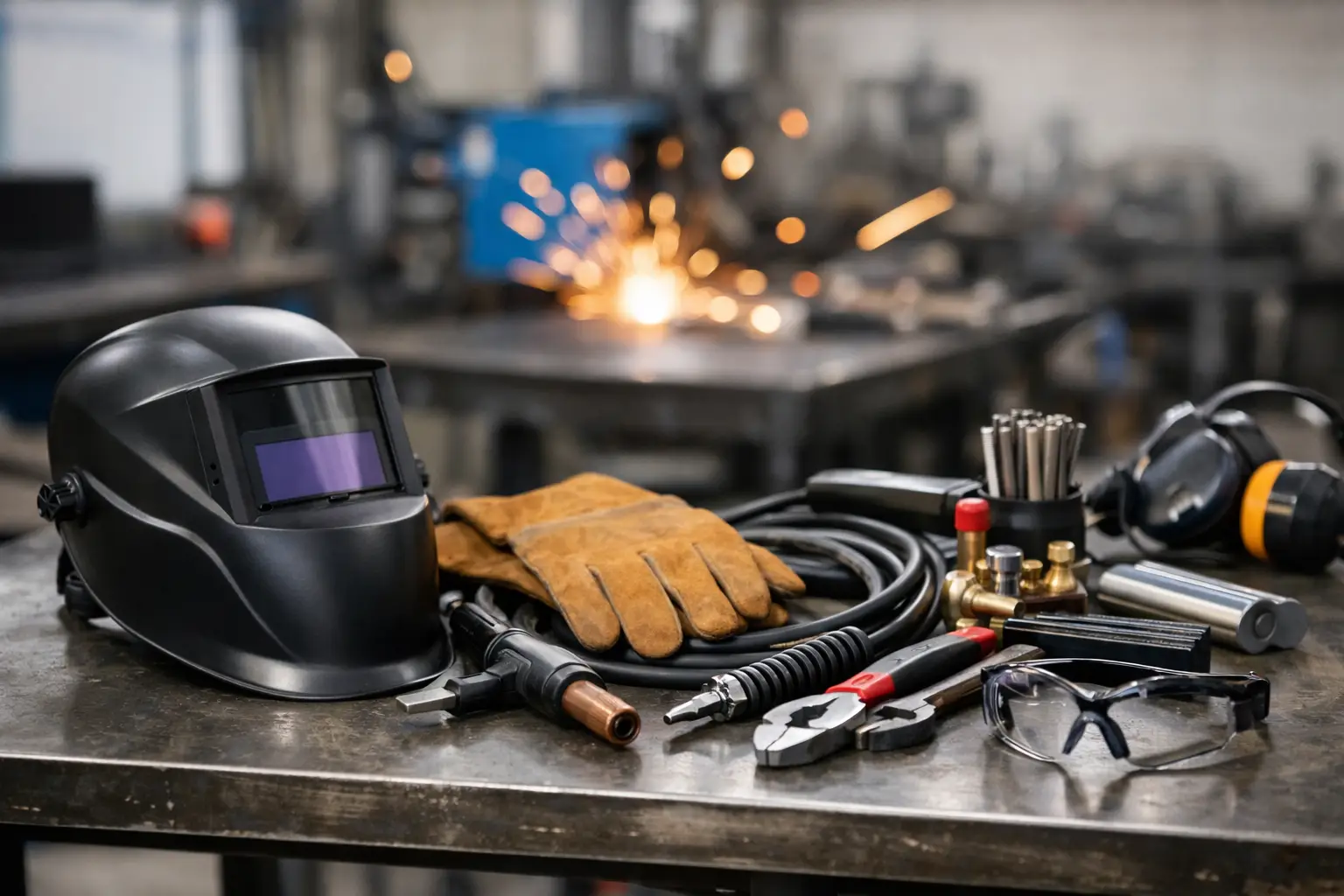
A student welding starter kit should make the first term safer, easier and less expensive – not fill a locker with tools that never leave the packaging. Most colleges provide the large equipment, extraction and workshop machines. Your job is to turn up with dependable personal protection, the right hand tools and consumables that match the welding process you are actually being taught.
The common mistake is buying a cheap all-in-one bundle before speaking to the tutor. A MIG-focused course, for example, needs different gloves, wire and torch spares from a TIG unit. Start with the essentials, check the college requirements, then add equipment as your projects and confidence grow.
Start with the college welding requirements
Before spending a pound, ask which processes you will use in the first term: MIG/MAG, TIG, MMA/Stick, oxy-fuel cutting or plasma cutting. Also check whether the workshop supplies welding helmets, gloves, jackets, gas and consumables, or expects students to bring their own. Colleges vary widely, and some only permit approved consumables or PPE in practical areas.
Find out the machine and torch types too. If you are likely to use a standard Euro torch on a MIG set, replacement contact tips and shrouds are easy to source. A machine fitted with a specific torch, however, may need different spares. Compatibility matters more than picking the lowest-priced pack on the shelf.
It is also worth asking what material thicknesses and grades are on the course. Mild steel practice pieces are forgiving, but stainless steel and aluminium introduce different filler, wire, gas and cleaning requirements. There is no value in buying aluminium MIG wire because it looked useful if you will not touch aluminium for another year.
The core student welding starter kit
Personal protective equipment is where a starter kit earns its keep. It is used on every job, protects the welder rather than the bench, and is usually the first equipment a student will want to replace if the supplied gear is worn, badly fitting or inconsistent.
A proper auto-darkening welding helmet is the centrepiece. Look for a helmet with reliable arc sensors, an appropriate variable shade range and controls that are straightforward to operate with gloves on. For general MIG and MMA training, a shade range covering common welding work is sensible. TIG can demand more sensitive sensors, particularly at lower amperage settings. A clear grinding mode is useful, but it does not replace proper eye protection when grinding.
Choose a helmet that fits securely without becoming uncomfortable halfway through a practical session. A larger viewing area is useful for positional welding and fillet welds, though it may cost more. The cheapest helmet is rarely a bargain if poor headgear slips every time you nod into position.
Gloves should match the process. MIG and MMA welding generally benefit from durable leather gauntlets that can cope with heat, spatter and regular handling of steel. TIG gloves are thinner, softer and designed for the dexterity needed to feed filler rod. One heavy pair and one TIG-specific pair is a sensible purchase if the course covers both processes. Do not use wet, split or badly burned gloves simply because they are still in the kit bag.
Flame-resistant workwear is equally practical. A welding jacket or sleeves protect against sparks and spatter, while a leather apron is useful for bench work. Cotton work trousers and a long-sleeved cotton top are preferable to synthetic clothing, which can melt when exposed to heat. Steel toe-cap safety boots with secure ankle coverage are the sensible standard for a welding bay. Trainers have no place around hot offcuts, dropped plate and grinding debris.
A useful personal PPE set includes:
- An approved auto-darkening welding helmet and clear safety spectacles
- Process-appropriate welding gloves, plus a spare pair for when one gets damp
- Flame-resistant jacket, sleeves or apron for the work being carried out
- Steel toe-cap safety boots and hearing protection for grinding areas
- Suitable respiratory protection only where specified by the college risk assessment
Do not treat a disposable dust mask as an answer to welding fume. Good local exhaust ventilation is the main control in a workshop, and respiratory protection must be selected for the task and used properly. Follow the college’s safety rules, particularly around extraction, hot work areas and grinding bays.
Buy consumables after checking the process
Consumables are easy to overlook until a practical lesson stops because a contact tip has worn or your tungsten has been contaminated. A small, process-specific reserve saves time, but it must be the right reserve.
For a MIG student, that may mean suitable contact tips, a spare shroud, nozzle gel or anti-spatter product where permitted, a wire brush and the correct wire diameter for the course machine. Many training workshops use 0.8 mm mild steel wire, but that is not a universal rule. Check before buying. Keep tips and shrouds clean, and never force a wire size through a mismatched tip.
For TIG, the useful extras are correctly sized tungstens, collets, collet bodies, ceramic cups and filler rods specified for the material. TIG consumables are small, easy to lose and simple to mix up. Store them in labelled tubes or a compact organiser so contaminated tungsten does not find its way back into clean stock.
MMA students should only buy electrodes once they know the type, diameter and storage expectations. Electrodes that have been left in damp conditions can cause poor starts and weld defects. It is better to buy a small quantity of the right rods than a large mixed pack that sits in a garage absorbing moisture.
Hand tools that will actually get used
A student does not need to arrive with a fabrication shop in a toolbox. A compact set of quality basics will handle most preparation, fit-up and clean-up work. Include a 300 mm steel rule, tape measure, combination square, permanent marker, soapstone holder, centre punch and a decent pair of locking pliers. A welding chipping hammer and wire brush are useful for MMA work, while a magnetic square can help with basic fit-up, provided it is kept away from the weld area when it interferes with access or attracts grinding dust.
An angle grinder is often supplied by the college, and that is usually best. It needs the right guard, disc type, inspection routine and training. If you are buying one for home practice, choose a recognised model, use discs rated for the grinder speed and wear the correct eye, face and hearing protection. Never treat a grinder as a casual add-on to a welding kit.
Should a student buy a welding machine?
For most first-year students, no. Use the college machines first. They let you learn settings, torch control, preparation and weld quality without committing to the wrong process or machine specification. A good workshop also gives access to equipment that may be beyond a beginner’s home budget, including higher-output MIG sets, AC/DC TIG machines and proper fume extraction.
A machine makes sense for regular home practice, side projects or an apprenticeship where it will be used often. In that case, buy for the work you expect to do, not the biggest amperage figure on the box. Consider the available 230V supply, input plug, duty cycle, machine weight, service support and the genuine availability of torch spares and consumables. A MIG machine is often the most practical first purchase for mild steel fabrication, while DC TIG suits cleaner, more controlled work on steel and stainless. Aluminium TIG generally calls for AC capability.
Avoid a no-name package that includes a helmet, leads and a handful of accessories but offers no credible parts backup. Welding equipment works hard. Being able to obtain a tip, liner, torch part or repair support quickly is worth far more than a bundle of low-grade extras. A specialist supplier such as Linc-Weld can help match a machine and consumables to the process, rather than leaving a student to guess from product photos.
Keep the kit ready for the next practical
Use a tough toolbox or holdall with separate space for clean PPE and dirty hand tools. Keep spare helmet lenses protected, dry gloves after use and remove grinding dust from the helmet and jacket before packing them away. Label your tools and consumables. In a busy college workshop, identical wire brushes and squares disappear quickly.
Buy the gear that keeps you safe, supports the process on your timetable and can still serve you when you move into an apprenticeship or workshop role. A well-chosen starter kit is not about looking fully equipped on day one. It is about being ready to learn properly every time the arc is struck.