
Welding Cable Size Guide for Reliable Power

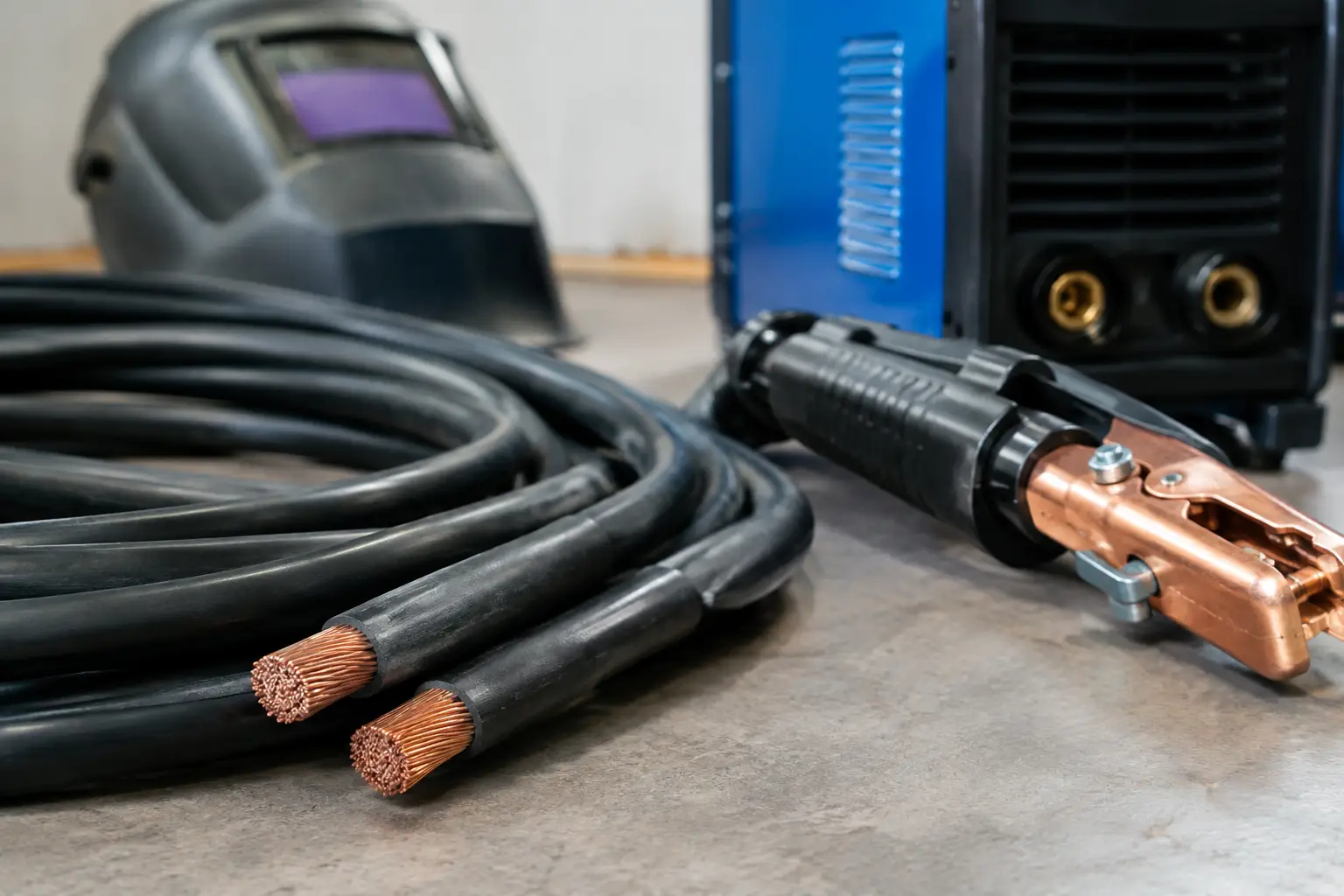
A machine can be rated for 300 amps, but that does not mean a thin, over-long lead will deliver 300 amps cleanly at the job. Poorly sized welding cable creates voltage drop, excess heat, weak arc performance and connectors that fail long before they should. This welding cable size guide gives you a practical starting point for choosing copper welding leads for MIG, TIG and MMA work.
Cable selection is not just about the output rating printed on the welder. You need to account for welding current, duty cycle, the full length of the circuit, process, environment and the quality of the return clamp and connectors. Get those details right and the machine performs as intended. Get them wrong and even premium welding gear can feel underpowered.
Welding cable size guide: the three figures that matter
Start with amperage, total circuit length and duty cycle. Amperage is straightforward: a 250A MMA set places a much heavier load on cable than a 160A TIG inverter. Length is where many cable choices go wrong. Current travels out through the torch or electrode lead and returns through the earth lead, so both leads must be considered.
For example, if the electrode holder lead is 10 metres and the return lead is 10 metres, the working circuit length is 20 metres. A cable size that performs well at a bench may be too small when the machine is parked outside a vessel, across a fabrication bay or at the bottom of a site access stairwell.
Duty cycle also changes the answer. A cable used for short, intermittent tack welding can tolerate a different workload from one feeding sustained MMA runs at high current. If your work regularly pushes the machine near its maximum output, select cable for that real-world demand rather than the occasional low-amperage job.
Quick cable size chart for flexible copper welding cable
The table below is a sensible guide for good-quality, flexible copper welding cable on a typical workshop or site setup. Length means the combined positive and return cable length. It is deliberately a practical starting point, not a substitute for the cable manufacturer’s current rating or a machine manual.
| Welding current | Up to 10m total circuit | Up to 20m total circuit | Up to 30m total circuit | |—|—:|—:|—:| | Up to 160A | 16mm² | 25mm² | 35mm² | | Up to 200A | 25mm² | 35mm² | 50mm² | | Up to 250A | 35mm² | 50mm² | 70mm² | | Up to 300A | 50mm² | 70mm² | 95mm² | | Up to 400A | 70mm² | 95mm² | 120mm² |
If in doubt between two sizes, go up a size where the job involves long leads, high duty cycle, outdoor work or frequent high-amperage welding. Larger cable costs more and is less convenient to handle, but it usually pays for itself in better arc response, lower losses and longer connector life.
Why total length matters
Every metre of cable adds resistance. Resistance turns electrical energy into heat and reduces the voltage available at the arc. The result can be difficult starts, inconsistent penetration, excess spatter and a machine that appears to lack output.
MIG welding is particularly revealing because wire feed and arc stability depend on a consistent electrical circuit. With MMA, undersized leads can make rods harder to strike and maintain. TIG often runs at lower amperage, but long torch leads, water-cooled torches and sensitive work can still expose poor return connections or unnecessary voltage drop.
Do not assume the return lead is less important than the live lead. It carries the same welding current. Fit the same cable size on both sides of the circuit unless a qualified equipment specification states otherwise.
Match the cable to the welding process
For TIG work at modest current over short distances, 16mm² or 25mm² cable is often sufficient. That changes quickly when working with a larger AC/DC machine, a long torch package or aluminium at higher amps. The cable must suit the maximum output you genuinely intend to use, not just the usual setting for thin stainless.
MIG setups need attention to both the welding return and the torch assembly. The power cable inside a torch is part of the current path, so an under-rated torch can become the restriction even when the main return lead is correctly sized. Check the torch rating against the process, wire size, shielding gas and duty cycle. A torch rated at 250A with mixed gas may not have the same rating with CO2.
MMA and gouging applications are the hardest on leads. Stick welding commonly uses longer runs and sustained high current, while carbon arc gouging can put serious heat into every part of the circuit. Use suitably heavy copper cable, correctly rated electrode holders, solid return clamps and compatible DINSE plugs. A 50mm² lead attached to a light-duty connector is not a 50mm² system.
Copper quality, flexibility and insulation are not optional
Cable cross-section is only one part of the specification. Choose purpose-made flexible welding cable with fine-stranded copper conductors and tough, welding-rated insulation. It needs to flex repeatedly, tolerate workshop abuse and remain manageable in colder conditions.
Cheaper cable can look substantial because the outside diameter is large, while the conductor contains less copper than expected. Copper-clad aluminium cable is lighter and less expensive, but it does not perform like equivalent pure copper cable. For professional welding leads, especially on high-output sets or long runs, flexible copper cable is the dependable choice.
Inspect the marking on the cable where available. Confirm the conductor size in mm², temperature rating and intended application. If a lead feels unusually warm during normal welding, stop and investigate. Heat may indicate undersized cable, a damaged conductor, loose termination or poor contact at the clamp.
The return clamp can ruin a good cable setup
A high-quality lead cannot compensate for a weak earth connection. The return clamp should be rated for the current, fitted with clean jaws and connected directly to bright, solid parent material wherever practical. Clamping onto paint, rust, oily steel, a loose fixture or a long chain of workpieces adds resistance to the circuit.
For fabrication benches, keep the return arrangement clean and consistent. On site, reposition the clamp as the work changes rather than relying on an uncertain path through structural steel, hinges or temporary brackets. This improves arc performance and helps prevent localised heating at unintended contact points.
Check the cable lug, DINSE plug and clamp termination too. A loose crimp or burnt connector creates resistance at exactly the point carrying the highest current. Discolouration, hardened insulation, cracked plug bodies and loose fitment are all signs that replacement is due.
When longer leads are unavoidable
Long leads are often necessary in plant rooms, agricultural repairs, fabrication bays and structural work. The practical answer is not always to drag the welder closer, particularly where access, ventilation or power supply limits where the machine can sit. In those cases, increase cable size rather than accepting a poor arc.
Avoid joining leads unless there is no sensible alternative. Every joint adds another possible failure point and should use a proper, correctly rated connector – never twisted conductors, improvised clamps or taped repairs. Keep joints off wet ground and away from traffic routes where possible.
For mobile work, weigh up the handling trade-off. A 95mm² cable gives stronger performance over distance, but it is heavier to carry and harder to coil than 35mm². For a team that regularly welds 250A at 20 to 30 metres, that inconvenience is usually preferable to fighting voltage drop on every job.
A practical buying check before ordering
Before selecting leads, write down the machine’s maximum output, your usual working current, the expected positive and return lengths, and the process being used. Then check the ratings of the torch, holder, clamp, DINSE plugs and cable lugs. The lowest-rated component sets the safe limit for the whole circuit.
For workshops replacing worn leads, it is often worth standardising a few proven sizes rather than buying whatever is available in an emergency. A 25mm² set for lighter fabrication, 50mm² for general heavy work and 70mm² or 95mm² for long-run or high-output jobs covers many professional requirements. Linc-Weld can help match cable, connectors and consumables where a machine setup needs checking before purchase.
Choose cable for the work you are actually sending it into. A properly sized, well-terminated copper lead is not an accessory – it is the link between the welder you paid for and the arc you need on the job.